


 An overview of the TCWorld 2024 conference highlighting key discussions and trends shaping content strategy and technical communication. The article summarizes major insights on structured content, content operations, and the growing role of AI in managing and delivering enterprise documentation.



As organizations modernize documentation and content operations, understanding current trends in structured content, AI adoption, and scalable content management has become critical for content and documentation teams.
TCWorld Conference
5 Nov 2024 - 7 Nov 2024 / Stuttgart, Germany
| Presentation | Speaker |
|---|---|
| Operations Workshop: How to find, quantify, and present operational efficiencies | Rahel Bailie |
| So much waste, so little strategy: The reality of enterprise customer content | Sarah O‘Keefe |
| Lessons Learnt from Deploying Multiple GenAI Use Cases | Sam George |
| Transformation einer Technischen Dokumentation durch CCMS | Busch, Ernecker |
| The DITA Tales – a bumpy ride of implementing DITA in a small documentation team | Hietala |
| Mastering Content Design and Information Architecture | Stern |
| Moving from Monolithic to Modular Documentation | Roth, Faltenbacher |
| Your AI Isn‘t Broken, Your Content Is: How to Maximize Your Investment in Emerging Technologies | Preciado |
Inside TCWorld 2024: Content Strategy in Focus #
For content strategists, keeping up isn’t optional - it’s part of the job. As digital products grow more complex and user expectations shift, the way we plan, structure, and deliver content has to evolve too. Conferences are a rare chance to step out of day-to-day routines and dive into big-picture thinking where trends, challenges, and new tools get shared openly. They’re also one of the few spaces where strategists, writers, designers, and engineers come together to explore what’s next for content.
Among all the international events for content and communication pros, the TCWorld conference stands out with its technical depth, global perspective, and the diversity of voices it brings into the conversation.

Hosted annually in Germany by tekom, Europe’s largest professional association for technical communication, TCWorld has been a key event in the field since the early 2000s. While it started out focused on technical documentation and information development, the conference has grown to include topics like UX writing, structured content, terminology management, and enterprise content strategy.
The program combines keynote talks, breakout sessions, tool demos, and plenty of networking opportunities, both in Stuttgart and online. With presentations in English and German and a strong lineup of international speakers, TCWorld provides a clear view into the cross-disciplinary realities of modern content work.
When it comes to content strategy, Europe is steadily catching up with the US. There, long-established conferences like Confab and LavaCon have been shaping the field for over two decades. Interest in content strategy is growing quickly in Europe too. For example, in 2023 TCWorld’s Content Strategy track featured just two talks. By 2024 that number had jumped to twenty, reflecting the rising demand for content expertise across industries.
Let’s take a closer look at the Content Strategy track at TCWorld 2024, at the technologies and methodologies currently shaping the field, and examine the themes that resonated most with the European audience.
Content Strategy Track
The Tekom conference program introduces the content strategy discipline as follows: 'A content strategy is a structured plan for the creation and distribution of information for use that takes into account the needs of the target audience and the business objectives. It includes defining goals, analyzing the target audience, selecting content types, and creating an editorial plan. Success is measured by monitoring and evaluating the content. By developing and implementing a content strategy, Technical Communication contributes to greater customer satisfaction and creates added value for the company.'
The talks in the Content Strategy track reflected the core elements of this definition, addressing audience and business needs analysis, content creation, distribution, and ongoing evaluation. Several talks focused on practical transformation journeys, such as implementing structured authoring and CCMS solutions, with sessions like 'The DITA Tales' and 'Transformation einer Technischen Dokumentation durch CCMS' sharing real-world lessons from introducing structured content in both small and large teams.
Another strong theme was the transition from legacy documentation models toward modular and strategically organized content. Talks such as 'Moving from Monolithic to Modular Documentation' demonstrated how teams are breaking large documentation sets into reusable components, while sessions like 'Mastering Content Design and Information Architecture' emphasized the importance of strong information architecture as a foundation for scalable documentation ecosystems.
Finally, multiple sessions addressed how content quality directly impacts emerging technologies and user experiences. Talks such as 'Your AI Isn’t Broken, Your Content Is' and sessions on data-driven documentation and content design emphasized that successful AI, automation, and learning experiences depend on structured, reliable content. Overall, the track illustrated a clear industry shift from writing documentation toward strategically managing content as a reusable business asset.
Optimizing Content Operations

The Content Operations hands-on workshop, led by Rahel Anne Bailie, a Content Solutions Director in TWi and FH JOANNEUM lecturer, focused on how content strategists can find, quantify, and present operational efficiencies to better support business objectives.
The workshop introduced the concept of improved content operations as a repeatable, scalable system for managing content across its lifecycle from creation to delivery and maintenance. This approach focuses on enabling scalability through a single source of truth and standardized processes, monitoring and analyzing operations for continuous improvement and risk management, and responding to demand by reducing inefficiencies and automating routine tasks.
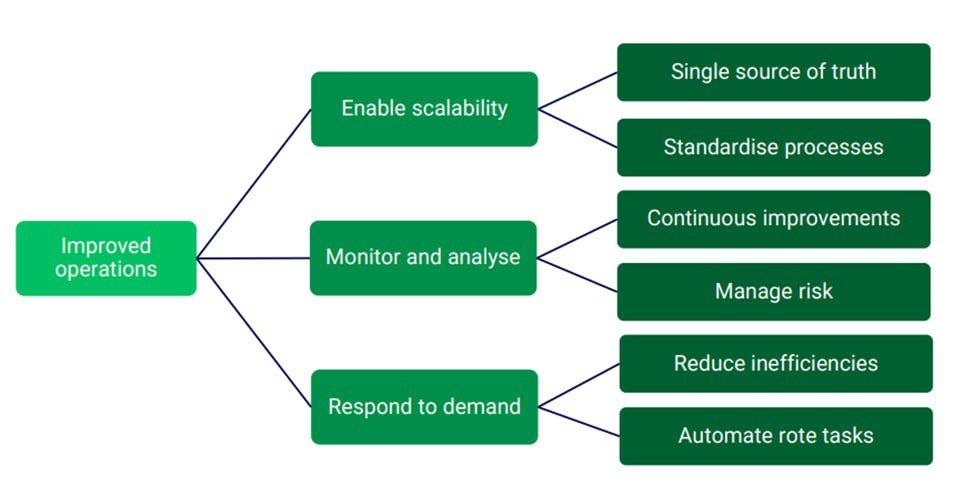
Workshop participants explored how operational efficiency can drive measurable business value by reducing content debt, minimizing waste (using the Lean-based TIMWOODS framework), and increasing reuse.
In content operations, waste often hides in plain sight, and the Lean TIMWOODS framework offers a useful lens to identify it. Transportation shows up as time wasted moving files between folders. Inventory includes outdated or duplicate content cluttering repositories. Motion appears when teams manually record actions in spreadsheets instead of using automated systems. Waiting is another drain, with manual review processes slowing down delivery. Overproduction leads to multiple copies of the same content, while overprocessing means creating unnecessary variants in separate files. Defects arise from hardcoding content directly into code, making updates cumbersome. Finally, poor skills utilization happens when skilled writers are stuck performing repetitive tasks that a computer could easily handle. Addressing these areas helps streamline workflows and free up teams to focus on high-value work.
Attendees engaged in structured exercises that included mapping existing workflows, identifying inefficiencies, optimizing content maintenance across multiple markets, and calculating ROI and time savings. Through real-world scenarios and guided practice, participants learned to quantify the value of content operations and present their findings in a way that resonates with both management and C-suite stakeholders.
So Much Waste, So Little Strategy: The Reality of Enterprise Customer Content
First-year students in the Content Strategy Master’s program at FH JOANNEUM take Rahel Anne Bailie's course Developing Content for Complex Digital Environments. The course explores how to effectively plan, structure, and manage content in organizations where multiple content types are produced across siloed teams.

Sarah O’Keefe, CEO of Scriptorium, tackles the same topic in her conference talk. To solve the silo problem, she proposes creating a comprehensive solution for enterprise customer content. But how can this be achieved? Interestingly, the technological solution is not the issue. According to Sarah, the main problem is that content silos are a reflection of people and departmental silos. We develop and produce marketing content, technical communication content, support content, and learning content in silos because we belong to different groups and have different mindsets. As a result, our website content often reflects the org chart structure rather than user flows.
Sarah recommends auditing corporate siloed content from four perspectives: Authoring, Storage, Design, and Governance. This analysis helps understand whether the content is fragmented, consistent, or connected. Our ultimate goal is to get connected content.
From the Authoring perspective, if we analyze the content objects existing in the various content silos we support, we may see multiple overlaps. For example, the Learning and Technical/Product content typically overlaps by about 75%. To reuse such content, authors have to move the content objects or copy-paste the information.
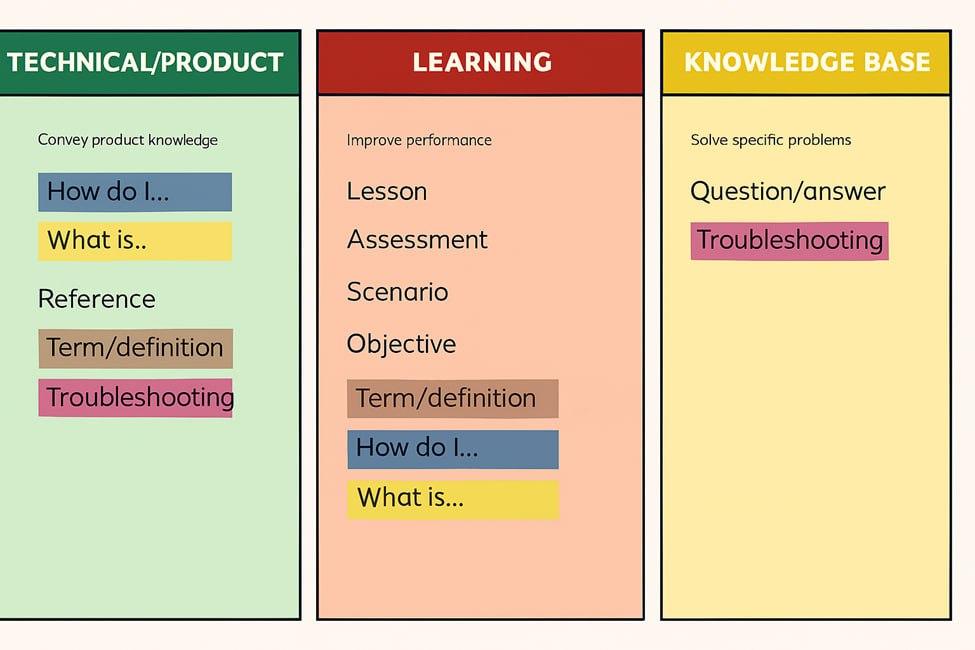
Fortunately, this type of authoring problem can be solved with the content management systems (CMS), but only if the CMS is used across the entire organization, which is a rare case.
Another problem arises with storage solutions when different corporate content developers use different tools and siloed repositories for their content domains (in our example: product documentation, learning, and support).

Converging on a single repository (or tool) with shared access and publishing can be a valuable step forward. However, it comes at a cost, often requiring compromises in authoring.
Sarah O’Keefe wraps up her talk with clear calls to action:
- For authors: connect with other groups, eliminate content duplication and copy-paste practices, and focus on building efficient publishing pipelines.
- For developers: design for multiple content types and enable cross-system connections.
Lessons Learnt from Deploying Multiple GenAI Use Cases
The Content Strategy program at FH JOANNEUM offers multiple opportunities for students to explore scenarios for applying GenAI in their professional assignments. But how to transition from experiments to established practices and processes?

Sam George, Director of Cisco's Technical Documentation group, recommends focusing on feasible, relevant use cases and delaying long-term future GenAI investments.
Sam shared lessons learned from his team’s journey with GenAI. They decided to focus on the two goals:
- Reduce content authoring effort
- Increase content quality and findability
The team identified the following GenAI content workflows:
- Content editing
- Content draft creation
- Style guide compliance
- Contradictory content check
- In-product assistance
- Video creation
- Personalized chatbot
For each workflow, they built a Proof-of-Concept, assessed the risks, and calculated an increase in productivity, quality, and customer engagement. For example, using the Lumen5 AI tool to generate videos based on their technical content, they saved 60% of effort.
However, according to Sam, developing a training plan is the most critical part of the GenAI journey. He established a solid plan to upskill and support both his authors and leaders. Sam started with general awareness training for the writing team to align expectations and build confidence. Then, he provided hands-on workshops where they could practice prompt engineering and explore specific GenAI tools.
Sam also highlights the importance of bringing leadership onboard, for example, by prioritizing certification for managers so they can advocate for these changes and help embed them into team culture.
To sustain progress, Sam and his research group created a knowledge base for quick reference and set up support forums where authors could exchange insights and resolve issues together.
Regular refresher sessions help keep skills sharp and adapt to the fast-evolving GenAI landscape.
Sam claims that with the right investment in people, the authoring team will be ready to get the most out of GenAI and avoid the pitfalls of a tool-first approach.
Conclusion
The TCWorld 2024 Content Strategy track showed a strong focus on making operations more efficient, adopting structured content, and preparing content teams for the future powered by GenAI. The TCWorld 2025 conference is coming, and we already observe a growing focus on content governance and operational efficiency, alongside a clear emphasis on breaking down silos between teams, using data and analytics to drive decisions, and building content ecosystems that support AI and automation. This year’s program shows a further evolution of the content strategy from a niche discipline into a critical enabler of enterprise-wide transformation.