


 An overview of the LavaCon 2025 conference for content strategists, covering the key themes from the event and what they mean in practice. The article highlights major talks, emerging trends, and real-world takeaways on structured content, metadata, and AI-ready documentation for enterprise teams.

As organizations adopt AI-driven search, automation, and personalized content delivery, content strategy is shifting from page-centric publishing to structured, reusable, and semantically enriched information. LavaCon 2025 addressed these changes, making it highly relevant for content strategists preparing their content ecosystems for AI-powered consumption and enterprise-scale reuse.
LavaCon
5 Oct 2025 - 8 Oct 2025 / Atlanta, GA
| Presentation | Speaker |
|---|---|
| Expanding Self-Service for a Better Customer Experience | Lief Erickson, Principal Content Strategist, Intuitive Stack and Dave Marotz, Director, Product Innovation, Surescripts |
| The Role of Metadata in Managing Content in Unified Portals & AI-readiness | Noz Urbina, Omnichannel Strategist, Urbina Consulting in Collaboration with Bluestream |
| Embracing the Age of Fluid Content | Stefan Gentz, Principal Worldwide Evangelist, Adobe |
| Broken Trust, Broken Docs: Fixing the Hidden Gaps Undermining Your Technical Content | Rob Hanna, CEO and Co-founder, Precision Content |
| The Curators of Truth: Elevating Knowledge in the Age of AI | Jason Kaufman, CEO, Zaon Labs |
| Why Technical Writers Should Care About Governance, Risk, and Compliance (Even if It Sounds Boring) | Megan Gilhooly, Sr. Director GRC Content, OneTrust |
| The Experimentation Mindset: How Testing Transforms Content Strategy | Melinda Belcher, Executive Director, JPMorgan Chase |
| From Silos to Synergy: A Governance Framework for Building Bridges Across Teams | Leslie Farinella, President, Content Rules |
LavaCon Conference: What’s on the Content Strategist’s Agenda in 2025-2026 #
For nearly two decades, the LavaCon Content Strategy Conference has occupied a unique niche in the professional domain. It was founded with a mission to help organizations 'reduce costs, increase revenue, and improve the Customer Experience through better content’. The event has historically been a gathering place for documentation managers and content strategists to share ‘lessons learned’. According to FH JOANNEUM lecturers, Rahel Bailie and Noz Urbina, who are also frequent speakers at LavaCon, this conference is a key professional event for content strategists worldwide.
In October 2025, the LavaCon conference was held in Atlanta, Georgia. While the event featured a dedicated track for Artificial Intelligence and Machine Learning, attendees found that AI was not just a topic - it was the ‘star of the show’, penetrating into every keynote and breakout session.
Conference Tracks and Key Themes
While the whole conference program always rotates around the content strategy domain, formally, in 2025, the event introduced the following tracks:
- Content Marketing and Content Strategy
- Customer Experience and Governance
- Content Development and Content Ops
- Artificial Intelligence and Machine Learning
- Tools and Technology
Jo Chapman and Toni Ressaire, Content Strategists from Altuent, highlighted the following key themes discussed at the conference:
- AI as the New Customer: The most important takeaway from Atlanta was a fundamental redefinition of the audience. Experts claim that AI will now serve as the primary direct consumer of content, with human users becoming the indirect consumers. In this emerging ecosystem, LLMs act as the ‘heavy-lifters’, ingesting documentation to transform information into the specific knowledge customers need. This shift requires a change in metrics. As keynote speaker Stefan Gentz noted, ‘Time to answer’ is the new KPI that matters.
- Content Guardians: For the attendees, primarily those from structured content and XML backgrounds, the rise of AI means a transformation in their daily roles. Content authors are evolving into a higher-level responsibility: becoming ‘guardians of the content’. Content teams are becoming AI enablers and orchestrators who work with Subject Matter Experts (SMEs) to define the source of truth.
- Trust and Credibility: Integration of AI introduced a trust crisis, which became a dominant theme throughout the conference. Rob Hanna’s keynote, ‘Broken Trust, Broken Docs’, introduced a framework of trust factors, arguing that while human-written content is generally presumed trustworthy, AI-generated content is viewed with skepticism. Presenters like Jason Kaufman of Zaon Labs advocated for ‘smart prompts’, which is a prompt engineering process to ensure AI relies only on validated, expert content. Similarly, Megan Gilhooly from OneTrust emphasized that safety policies and compliance must be embedded directly into AI workflows, particularly regarding data privacy.
- Strategic Experimentation: Beyond the existential questions of trust, LavaCon 2025 offered practical strategies for implementation. Melinda Belcher from JP Morgan Chase championed an experimentation mindset, urging organizations to focus resources on initiatives that actually ‘move the needle’ regarding business goals to make incremental improvements. This aligns with the views of Leslie Farinella from Content Rules, who highlighted the need for central governance teams that can negotiate with local silos to drive enterprise-wide efficiencies.
Despite the enthusiasm, some experts identified a missing link in the conversations in Atlanta. While terms like ‘taxonomy’ were frequently mentioned, deep discussions on semantics and metadata were largely absent, with just a few exceptions, such as talks by Lief Erickson and Noz Urbina.
Expanding Self-Service for a Better Customer Experience

The second-year students of the Content Strategy Master’s program at FH JOANNEUM take an Information Architecture course from Lief Erickson, a co-founder of Intuitive Stack consultancy for businesses with outdated technical documentation practices.
At LavaCon 2025, Lief shared a business case that enabled their client, Surescripts (represented by another speaker, Dave Marotz), to reduce onboarding time by 70%. By tagging content to specific roles, mapping it to the customer journey, and eliminating or fixing redundant efforts, they built a system that actually works.
Lief and Dave started by outlining the original problem Surescripts had been dealing with for many years: all their content was shipped to customers in PDF format. Multiple interconnected PDFs created in silos, sometimes outdated, were quite familiar to old customers, but became a real barrier to any CX improvements that could attract new customers. Lief’s team, operating on the Content Strategy Quad (Business Needs, Customer Needs, Operations, and Technologies), developed a transformation strategy that included changes to the information architecture and content development workflows. The plan also accounted for additional training for Surescripts teams involved in content development and maintenance.
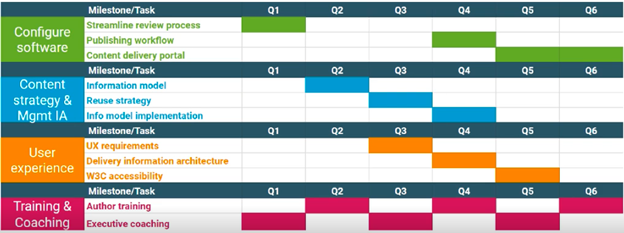
The business goal they had to address was reducing the support time by 70% within 12 months. Optimizing the onboarding process was the top priority. Lief’s team spent several months mapping detailed user journeys for key personas, and one of the biggest surprises was the number of customer touchpoints that the Surescripts content covered in silos.
Another piece of work introduced by Intuitive Stack for Surescripts was the componentized HTML format and semantic information modeling enriched with metadata. Both Lief and Dave emphasized the importance of the company converging on a shared taxonomy and context-rich metadata, thereby improving both the human search experience and customer interactions with the content through AI interfaces. If a company wants AI to accurately recommend its products or answer user questions, it must build a semantic layer that bridges the gap between raw content and machine understanding.
The Role of Metadata in Managing Content in Unified Portals & AI-Readiness

The importance of the semantic layer and structured content was a central theme of a talk by Noz Urbina, a co-founder and Programme Director of the OmnichannelX Conference and Podcast. Noz is also co-author of the book Content Strategy: Connecting the dots between business, brand, and benefits and lecturer in the Master’s Programme in Content Strategy at the University of Applied Sciences of Graz, Austria.
If Lief Erickson comes to the semantic richness requirement through a particular business case, Noz Urbina provides an industry-level justification. He argues that metadata is a universal solution that helps deliver the right content at the right moment to the right audience. Besides that, metadata supports trust and enables getting insights into content performance. To cover these needs, we have a rich scope of metadata: descriptive/semantic, structural, administrative, provenance, technical/system, and usage. But to reach a true semantic richness, we need to
integrate metadata at the deep element level of the structured content:
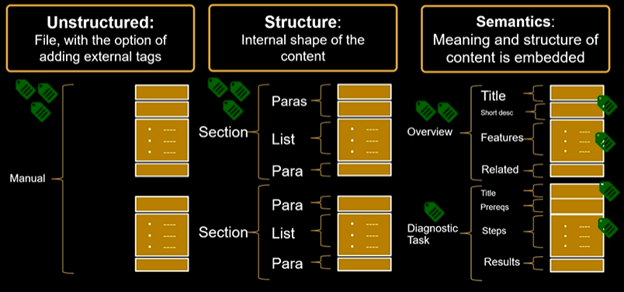
With this level of semantic depth, the right content could be extracted by AI chatbots from a system of interconnected content and knowledge management platforms:
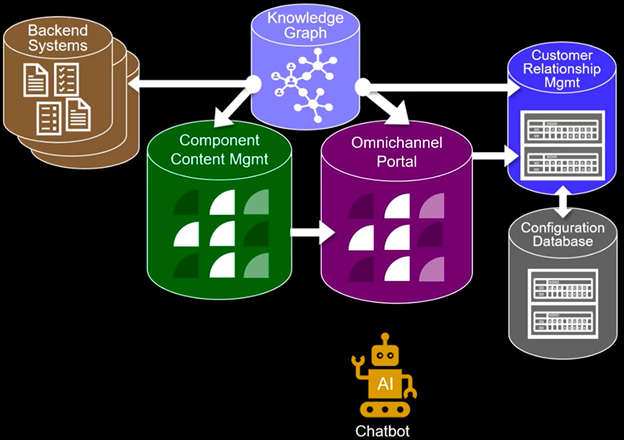
Noz recommends that content strategists enable the semantic layer through the following metadata sub-disciplines:
- Domain Model: The concepts we are talking about.
- Content Types: The containers for what we want to say about our concepts.
- Content Model: A set of content types and their relationships.
- Taxonomy: The lists of tags that organize what we want to say.
- Ontology: The full specification of all the tags and their relationships, contextualizing our content.
- Navigation/IA: The pathways through content in an interface.
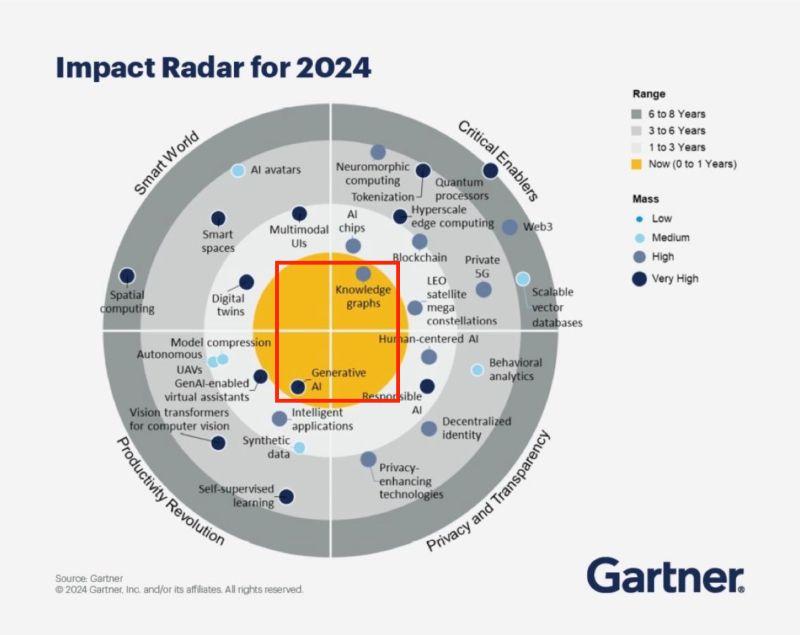
According to Noz’s findings, LLMs work best with metadata-driven DITA XML sources and Knowledge Graphs. This is why, for example, Gartner places Knowledge Graphs and Generative AI as the immediate technology focus in its Impact Radar 2024:
Conclusion
LavaCon 2025 illustrated an industry in transition, moving from the initial hype around AI to the complex reality of implementation, governance, and scale. Across talks and case studies, an important message emerged: AI readiness is inseparable from semantic structure. Without well-defined metadata, consistent terminology, and a robust semantic layer, neither automation nor generative AI can deliver reliable, trustworthy outcomes.
The content professional of the future is therefore no longer just a writer, but an architect of information models, knowledge graphs, and metadata frameworks that enable machines to understand content in context.
As the community looks toward the 2026 conference in Charlotte, the focus will likely shift from experimentation to operationalization: how to embed semantic modeling, knowledge graphs, and metadata governance into the content lifecycle in ways that reduce costs, generate revenue, and scale AI responsibly without laying off the teams needed to guard the machines.