

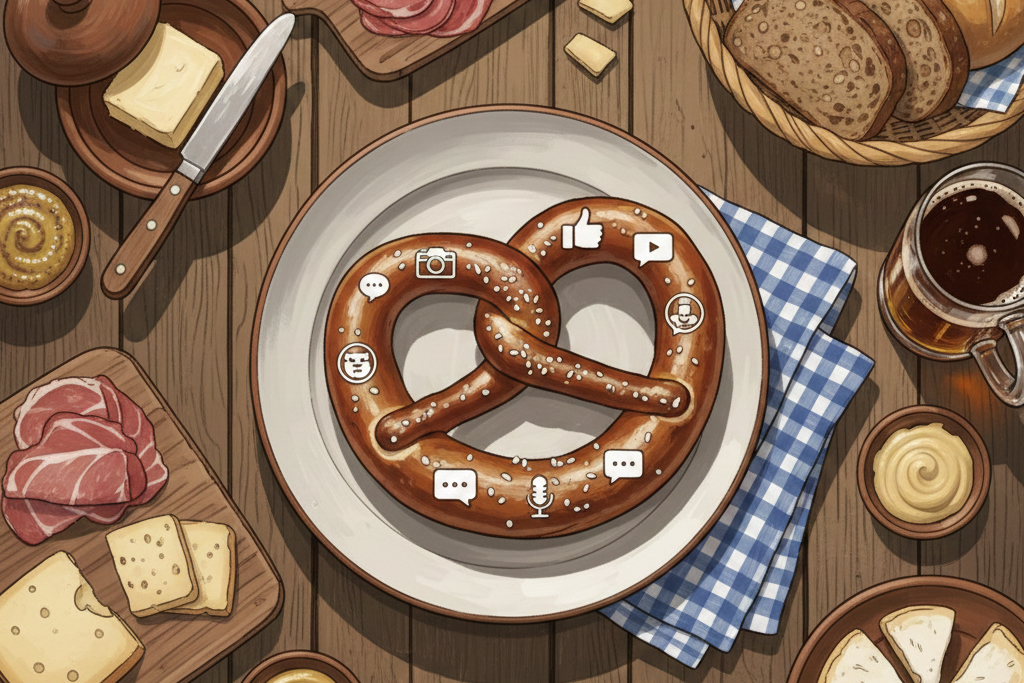
 The traditional linear marketing funnel is outdated. The Purchase Pretzel model reflects the messy, non-linear reality of modern customer journeys, where consumers loop between research and emotion. To succeed, brands must integrate persuasive marketing with high-quality informational content, providing the right facts at every touchpoint to build trust and drive final decisions.



The model is particularly relevant for Content Strategists and Technical Communicators. It proves that "dry" technical data is actually a powerful sales driver. When users loop through the pretzel, they seek validation; having technical facts ready at the "Interest" stage can be the difference between a bounce and a conversion.
Introduction: What Changed in Communication #
With the rise of digital technologies, the evolution of the web, and the explosion of new devices and platforms, the way we communicate and publish content has changed significantly. Publishing is no longer limited to journalists or media companies. Today, every organization and every individual has a space in the digital world where they can create, share, and influence.
This shift has created an information‑rich environment in which customers have access to more content, more opinions, and more choices than ever before. As a result, their behavior has become far less predictable. Customers don't follow a fixed path anymore; instead, they move between different platforms and use several devices at the same time. They might start their journey at any given point, and they may care more about what their peers say, what they find in independent reviews, or what algorithms show them than about a message controlled by a company.
Because of this shift, businesses can't just tell one single story and hope it works for everyone. There is a much bigger need to have the right information ready exactly when and where a customer is looking for it. For anyone working in content strategy, this means the main priority has changed: the goal is now to figure out exactly what kind of information a customer needs at every single touchpoint to make sure their questions are actually answered.
Challenging Conventional Marketing Approaches #
For decades, marketing relied on the concept of the “linear funnel.” This traditional model assumes that a brand can guide customers in a structured, predictable way through fixed stages—from lead to prospect to final sale. Within this model, information is delivered step by step, based on the assumption that customers only need certain details once they reach a specific stage.
In practice, customers often search for technical specifications, product details, or support-related information long before they make direct contact with a brand. As a result, conventional models increasingly struggle to reflect today’s reality and fail to capture the full complexity of modern customer behavior.
Conventional models face several key challenges:
- Non-linear journeys: Real customer journeys rarely follow a straight path. Instead of moving smoothly through predefined stages, customers jump back and forth between touchpoints and research phases. They revisit information, skip steps, or engage with content out of sequence, often bypassing the “planned” flow of a traditional sales funnel.
- Customer expectations: Today’s consumers expect quick access to relevant information that is tailored to their specific situation, giving them the confidence to take the next step. Rahel Anne Bailie notes that consumers seek clear, precise answers and prefer content that meets their needs at exactly the right moment.
The omnichannel shift: Content delivery has moved from a single-channel approach to a complex, omnichannel environment. Bailie argues that Omnichannel is an integrated way of responding to customer touchpoints, no matter where they occur. Touchpoints now arise across multiple platforms and contexts at the same time. In this landscape, the real challenge is ensuring that information remains consistent, accurate, and reliable across every platform where customers encounter it.
The Purchase Pretzel #
As these challenges became more visible, a new model emerged to address the growing complexity of content consumption and evolving consumer behavior. The technology entrepreneur Walt Doyle introduced the Purchase Pretzel model. This model uses a pretzel shape to illustrate the non-linear nature of modern customer journeys. Instead of following a straight path, consumers may start their decision-making process at any point, on any device, and interact with a variety of content types before making a purchase.
The pretzel-shaped model highlights how consumers loop between different stages and content, including social media engagement, independent research, and seeking social proof. Every customer's journey is unique, shaped by their personal needs and preferences, making the process dynamic and unpredictable.
Purchase Pretzel stages #
Despite this individuality, marketers recognize common stages within the Purchase Pretzel model. A customer may first encounter a brand on social media, through a search query, or via a recommendation. This initial moment of discovery creates awareness.
Following awareness comes the interest stage, in which consumers actively seek information, compare options, and evaluate the product using resources such as instructional guides, product details, and third-party content.
Next is the intent and validation stage, where consumers seek recommendations, reviews, and feedback on social media and other digital platforms. Here, they seek to understand how others have experienced the product before committing to a purchase.
Finally, after navigating these often overlapping stages, the consumer completes the purchase and, if satisfied, becomes a loyal brand advocate.
To successfully guide customers through this complex journey, companies must provide timely, relevant content tailored to each stage. This requires developing an omnichannel content strategy and content types that align with customers’ evolving needs and preferences.
Types of Content in the Model #
Content plays a crucial role in the successful customer journey. To better understand the content, we need to break down the two primary categories companies use. Traditionally, these have been treated as separate entities created by different departments, but that view is outdated.
- Persuasive (Marketing) Content: This is the shiny stuff. It sits at the top of the traditional funnel and is what the public sees most. Bailie calls this type of content a thin veneer over the actual substance. Its job is to build the brand and hook customers emotionally using status, vibes, and slick presentation.
- Informational (Technical) Content: This content informs and explains the products rather than persuading. In the past, this was classified as after-sales material, including troubleshooting guides, release notes, and maintenance routines. But today, the definition has shifted. Reframing technical content as informational means it now includes feature breakdowns and quick-start guides that people actually read before they buy.
Here is the thing: Customers don’t care about a brand’s internal departments. They don't think, "I am now leaving the marketing phase." Since purchasing decisions are messy and non-linear; people jump seamlessly between the marketing fluff and hard facts. This means informational content isn't just after-sales support anymore. It’s taking on a critical role in driving the actual sale.
The Impact of Informational Content on Purchase Decisions
Persuasive content might get a customer interested, but their ultimate goal is to make an informed decision. This is where informational content becomes the critical factor in the purchasing process.
Why Facts Drive Sales: The Trust Factor
In an information-rich environment, customers crave transparency, and according to the Nielsen Global Trust in Advertising Report, trust is the new currency. While recommendations from friends (earned media) are the number one, brand websites are the most trusted format in the category of owned media, trusted by 58% of global consumers.
Customers trust the official website more than ads (which poll between 47% and 29%). This owned space is exactly where informational content like technical specs, feature breakdowns, and guides lives. If this content is missing or purely marketing fluff, brands are missing out on the opportunity to leverage the trust that the channel inherently offers.
Validation in a Non-Linear Journey
As consumers loop through the twists of the Purchase Pretzel, checking reviews, asking friends, researching, they eventually hit a point where they need to validate their choice. They stop looking for inspiration and start looking for data: energy consumption, repairability, specs. The demand is massive. Bailie notes that in some cases, analytics show 90–95% of the material customers actively request is informational content, not marketing copy.
A Strategic Asset for Creative Briefings
The value of this content extends beyond the customer. It is also an internal game-changer. High-quality informational content can basically replace the old-school creative briefing. It gives creative teams a solid foundation. For example, instead of relying on vague information, copywriters can use the accurate feature descriptions. This lets them craft narratives that are engaging but bulletproof because they’re based on the product’s actual capabilities.
Critical Perspective #
The Purchase Pretzel offers a valuable shift in how we understand modern consumer behavior. It highlights the messy, looping, and unpredictable nature of real customer journeys and underscores the need for content that supports decision‑making at every turn. It also reinforces a broader organizational truth: companies can no longer operate in silos. To meet customer expectations, teams must collaborate across functions, and persuasive and informational content must work together with a unified tone, voice, and purpose.
However, while the Pretzel is a powerful mental model, it is not a step‑by‑step framework. It doesn’t tell organizations which content to create, how to structure workflows, or how to operationalize omnichannel delivery. Instead, it sets the stage. It challenges outdated assumptions, especially the idea of a predictable, linear funnel, and invites companies to rethink how they plan, create, and maintain content across the customer lifecycle.
This is where the Pretzel’s limitations become its strength. It doesn’t replace existing models; it reframes how we interpret them. When paired with a practical content‑planning framework such as See–Think–Do–Care (STDC), the Pretzel becomes even more useful. The Pretzel explains why journeys are non‑linear and why customers jump between informational and persuasive content. STDC helps teams respond to that reality by structuring content around intent and ensuring that every stage of the journey is supported with the right information.
In this sense, the Purchase Pretzel is best understood as a mindset shift. It challenges old assumptions but does not provide a clear workflow. When combined with frameworks like STDC, it helps organizations build content ecosystems that are both strategically grounded and behaviorally realistic.
Where to go from here #
Future Directions of Strategic Communication
Silos in Content Strategy – Why They Exist and How to Work Around Them
References #
Bailie, R. A. (2017). Expanding content scope to drive customer information needs [White Paper]. Adobe Systems Incorporated. https://business.adobe.com/resources/articles/whitepaper-expanding-content-scope.html
Nielsen. (2012, 10. April). Consumer trust in online, social and mobile advertising grows. https://www.nielsen.com/insights/2012/consumer-trust-in-online-social-and-mobile-advertising-grows/
Neil Patel. Why the Traditional Marketing Funnel is Sabotaging Your Conversion Rate. neilpatel. Neilpatel.
https://neilpatel.com/blog/marketing-funnel-sabotaging-conversion-rate/
Robin Heintze. (2025, 9. September). Quickly explained: This is how you reach your customers in all phases of the buying decision. Morefire
https://www.more-fire.com/ratgeber/see-think-do-care/
The Kickoff Workshop What is Content Strategy, taught by Rahel Anne Bailie, was part of the Content Strategy Program at FH Joanneum during the Winter Semester 2025/2026.