

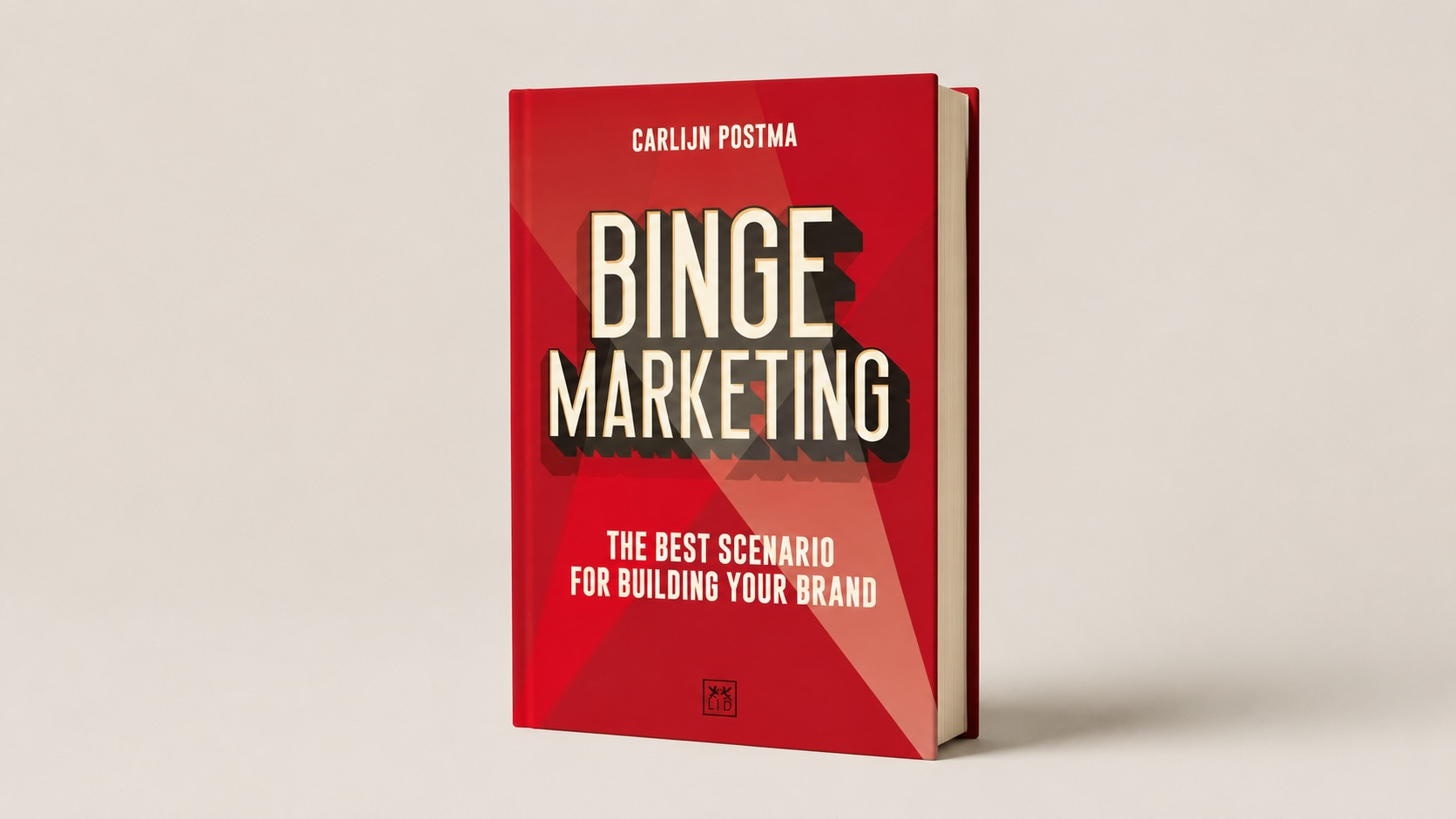
 Brands that treat every piece of content as part of one ongoing story outperform those still relying on one-off campaigns. This review breaks down Carlijn Postma's Binge Marketing framework and shows why thinking like a showrunner matters for content strategists today.


This article is a book review developed in the context of the course Cross-Platform Storytelling taught by Christoph Hofbauer. It explores the core principles of Carlijn Postma's Binge Marketing (2020), focusing on the shift from one-off messaging to serial content and the value of building connected narratives over time. These ideas are connected to cross-platform storytelling and real-world brand examples, highlighting their relevance for today's content strategists.
What if a brand's content could be as addictive as a Netflix series? That is exactly the question Carlijn Postma explores in Binge Marketing (2020). Her starting point is a situation most people know well: the late night moment on the sofa where "just two episodes" turns into an entire season, pushed forward by cliffhangers and a story the brain simply cannot release. For Postma, this is not just a television habit, it is a model for how brands should communicate.
Postma (2020) defines binge marketing as "... a sustainable marketing strategy that allows you to build a long-term relationship with your audience through the use of serial content, based on the shared interests of your audience and your brand." (p. 13). The goal is to earn trust over time, not to grab attention in a single moment. The core ambition is clear: to get an audience to consume at least three pieces of brand content in a row, not because they have to, but because they genuinely want to know what comes next.
Why One-Off Campaigns No Longer Work #
For most of the last few years, marketing followed a simple logic. Brands built a campaign, turned it into a TV commercial, a print ad and paid to distribute it through mass media. Postma, who worked at an advertising agency during this time, describes it simply: one creative idea could be adapted to a handful of formats and reach could be bought through established channels.
Then social media changed everything. Platforms like YouTube, Facebook and LinkedIn appeared. They became the brands personal channels, which forced them to come up with more of their own content. No longer just advertising, but real content. Internal teams broke into separate groups. The result was a brand that felt inconsistent to its audience. Changing its message and tone depending on the channel, with no consistent story connecting the pieces. Each team chased its own goals: short-term targets meant to reach key performance indicators (KPIs) but never add up to anything lasting.
This is also where one-off campaigns fall short. They create a brief moment of visibility and then disappear. There is no story for the audience to follow, no reason to come back. As Postma (2020) states, "Bits and pieces of incoherent content are not enough, and neither is a stand-alone campaign" (p. 15). Serial content works because it builds on itself. A brand that resets with every campaign throws that advantage away before it even begins.
The Building Blocks of Binge Marketing #
If binge marketing is the ambition, then structure is what makes it possible. What Carlijn Postma outlines in Binge Marketing (2020) is not just a creative idea, but a system. One that borrows heavily from the logic of television series: clear formats, recurring elements and a deep understanding of the audience.
What follows in the book is a step-by-step breakdown of that system. Postma moves from mindset to execution, showing how brands can shift from fragmented content creation to something far more deliberate and cohesive.
Thinking Like a Showrunner
At the core of Postma’s framework is a change in role. Marketing is no longer about producing campaigns, but about managing a narrative. Or, as she writes: “Tell your brand’s story like a hit TV series – pour every message into a new episode” (Postma, 2020, p. 41).
This is where the concept of the showrunner comes in. Instead of separate teams working toward isolated goals, there needs to be a central vision guiding everything. Postma (2020) underlines this necessity: “... a single objective, supported and promoted by all, is essential” (p. 45). Without it, content quickly becomes disjointed or inconsistent.
A brand like Red Bull demonstrates this clearly. Its content, ranging from extreme sports videos to large-scale events, always ties back to one overarching idea: pushing boundaries. Each piece feels connected, as if it belongs to the same ongoing series.
Building a Series: Plot, Seasons and Episodes
One of the most tangible tools Postma introduces is the plot summary. She explains: “We pour the brand’s positioning, mission, vision, and the why, how and what… into a plot summary” (Postma, 2020, p. 50). This becomes the backbone of all content decisions.
From there, everything turns into an “episode.” As she notes, “Every piece of content you create can be considered an episode in your series” (Postma, 2020, p.59). These episodes can then be grouped into seasons, creating rhythm and continuity over time.
A strong example of this structure can be found in HubSpot. Its blogs, courses, and webinars all revolve around the same core narrative of growth and inbound marketing. Individually useful, they collectively form a continuous stream of content that audiences can keep returning to.
Importantly, this structure also allows for evolution. Instead of constantly reinventing the brand, Postma (2020) suggests that brands can “choose to replace just one or two ingredients” (p. 64). Much like a TV series introducing new characters, the core story remains intact while details evolve.
The Three-Dimensional Brand
Consistency in binge marketing goes beyond visuals. Postma argues that logos and color palettes alone are insufficient to meet the need for content.
Her solution is the three-dimensional brand guide, which includes not just design elements, but also themes, characters, tone of voice, and even sound. It defines how a brand feels across all formats.
A company like Nike illustrates this well. Whether through short social clips or long-form storytelling, its content consistently emphasizes perseverance and personal achievement. The emotional tone remains recognizable, regardless of format.
From Target Groups to Audience Worlds
Another key shift Postma proposes is moving away from abstract target groups toward lived audience experiences. This reframing pushes brands to think about how their audience experiences content, rather than how they can simply reach them.
Airbnb provides a clear example. Its content focuses on real stories of hosts and travelers, immersing the audience in experiences rather than presenting them with generic travel messaging. The result is content that feels personal and engaging.
The Audience as the Hero
Drawing from narrative theory, Postma incorporates the hero’s journey – but with a crucial twist. The brand is not the hero. The audience is. She explains that “the hero’s journey… is in fact the same journey your audience goes through” (Postma, 2020, p. 106). This positions the brand as a guide, helping the audience move from a need or challenge to a solution.
This is visible in how Apple structures its storytelling. Its content highlights what users create and achieve, rather than focusing solely on the product itself. The audience sees their own journey reflected, which strengthens engagement.
Formats, Series and Content Mapping
In the later chapters, Postma becomes more tactical. She emphasizes the importance of repeatable formats: “Create solid formats for the most promising categories from your audience’s journey” (Postma, 2020, p. 140). These formats provide consistency and make it easier to produce content at scale.
Equally important is pacing. She advises: “Try not to stuff each episode with as many topics as possible, but instead spread the content out over multiple episodes” (Postma, 2020, p. 142). This is what creates anticipation and encourages continued consumption.
A company like Salesforce applies this through structured content ecosystems such as learning platforms and video series. Rather than isolated pieces, the content is designed to be consumed over time.
Content and Distribution: One System
Finally, Postma (2020) highlights a common blind spot in marketing: the separation of content and distribution. She argues that “content and distribution are inextricably linked” (p. 75). While different platforms host different “episodes,” they all contribute to the same narrative. Short-form content can act as a trailer, long-form content as the main episode, and social interactions as extensions of the narrative. The goal is not just reach, but progression - moving audiences from one piece to the next.
An example of this approach is Patagonia. Its short Instagram clips tease sustainability campaigns, blog posts provide in-depth context, and community events offer direct engagement. Each platform is a step in the audience journey, moving people from awareness to deeper involvement with the brand’s mission.
How Consistent Storytelling Drives Engagement #
Binge marketing is not about producing more content. It’s about creating a connected ecosystem where every touchpoint reinforces the same story. Audiences move across platforms, and when each channel contributes to a consistent narrative, the experience feels coherent and compelling.
People follow series because each episode leads to the next; the same logic applies to brands. For modern content strategists, consistent storytelling means treating every platform as part of one evolving story, not isolated campaigns. The result is an audience that recognizes the brand, trusts its message, and keeps coming back for the next “episode”.
Theoretical Background: Why Ongoing Narratives Engage and Last #
The reason serial content works so well comes down to how the brain handles unfinished stories. Drawing on research by social psychologist Arie W. Kruglanski (2013), Postma explains that people have a basic need for cognitive closure, the brain needs a story to end before it can move on. As she puts it, the end of an episode is not the end of the story and that is what keeps audiences coming back.
What Postma describes here is well supported by research. In addition to cognitive closure, narrative engagement helps explain the process behind this. Green and Brock (2000) argue that stories can draw audiences in so completely that they temporarily lose touch with their real-world perspective. The more absorbed an audience becomes, the greater the story's potential to shape their beliefs and attitudes. Beyond engagement, stories also shape what people remember. Woodside et al. (2008) show that people naturally think in narrative patterns, and that stories reinforce memory far more effectively than isolated facts. For brands, this means that serial content does not just hold attention in the moment, each new episode adds to a story the audience already carries with them, making the brand easier to recall. Repeated exposure adds to this: the more often audiences encounter a brand, the more positively they tend to perceive it (Zajonc, 1968).
Together, these findings suggest that the effectiveness of serial content goes beyond keeping audiences entertained. By triggering cognitive closure, deepening narrative engagement and strengthening memory, ongoing stories create a brand presence that one-off campaigns cannot replicate.
The Trade-Offs of Binge Marketing #
Like any strategy, binge marketing has both strengths and limitations. Understanding both is essential for anyone considering the approach. Binge marketing can work very well, but only when done right. What makes it work is:
- Stories that unfold over time: Audiences respond best to stories that unfold over time. A single campaign creates a brief moment of visibility, serial content creates a reason to come back.
- Thinking in Series Builds Loyalty: Each serial content piece adds to a story the audience already knows, deepening their connection to the brand over time. Postma (2020) states "... a loyal, committed audience is more likely to accept or buy something from you than the accidental passer-by." (p. 14)
- Consistency Makes It Easier to Follow: When the story stays consistent, audiences can follow along easily. That consistency also strengthens the brand's identity over time.
But the same logic that makes binge marketing powerful also brings real challenges, these are worth keeping in mind before committing to the approach:
- High Production Demands: Binge marketing needs a steady flow of good content, there is no clear finish line like a one-off campaign. This requires dedicated resources, consistent storytelling and people who truly understand the brand over the long term.
- Risk of Rapid Audience Lapse: An audience that was pulled in by strong early content pieces can leave just as quickly if the quality drops or the story loses direction.
- Ad-Supported Monetization Challenges: Binge marketing is about building relationships, not quick sales. This creates tension with how most marketing budgets work, where short term results need to be shown quickly and justified regularly.
- Dependence on High-Quality Content: The whole approach only works if the content is good and relevant. If the story is weak or the topics don’t connect with the audience, people will simply not come back, making the investment largely ineffective.
- Content Fatigue: Even strong serial content has to compete in a very crowded space. Staying relevant gets harder as more brands adopt the same approach.
At the same time, brands also need to be careful not to overuse the very techniques that make binge marketing effective. Cliffhangers, emotional hooks and suspense can successfully encourage audiences to continue consuming content, but when these elements begin to feel repetitive or overly manipulative, they may trigger resistance instead of engagement. Binge marketing therefore only works sustainably when suspense supports a genuinely valuable story, rather than replacing it.
Conclusion #
In the end, Binge Marketing is not just a handbook for producing more content, but a call to rethink how stories are built, managed, and sustained. Postma’s framework pushes content strategists to move away from fragmented campaigns and toward coherent worlds of storytelling. It reminds readers that brands do not win by shouting the loudest, but by creating an experience their audience wants to keep exploring. Like a good series, the goal is not the post or the ad itself, but what comes next, the unfolding story that holds attention over time.
For content strategists, this means thinking less like advertisers and more like showrunners. It requires patience, creative discipline, and a willingness to play the long game. But for those who commit, the reward is an audience that does not just watch or read, but returns, episode after episode, because the story feels part of their own.
References #
Green, M. C. & Brock, T. C. (2000). The role of transportation in the persuasiveness of public narratives. Journal of Personality and Social Psychology, 79(5), 701–721. https://doi.org/10.1037/0022-3514.79.5.701
Kruglanski, A. W. & Fishman, S. (2013). The need for cognitive closure. In M. R. Leary & R. H. Hoyle (Eds.), Handbook of individual differences in social behavior (pp. 343–353). Guilford Press.
Postma, C. (2020). Binge marketing: The best scenario for building your brand. LID Publishing.
Zajonc, R. B. (1968). Attitudinal effects of mere exposure. Journal of Personality and Social Psychology, 9(2, Pt.2), 1–27. https://doi.org/10.1037/h0025848