

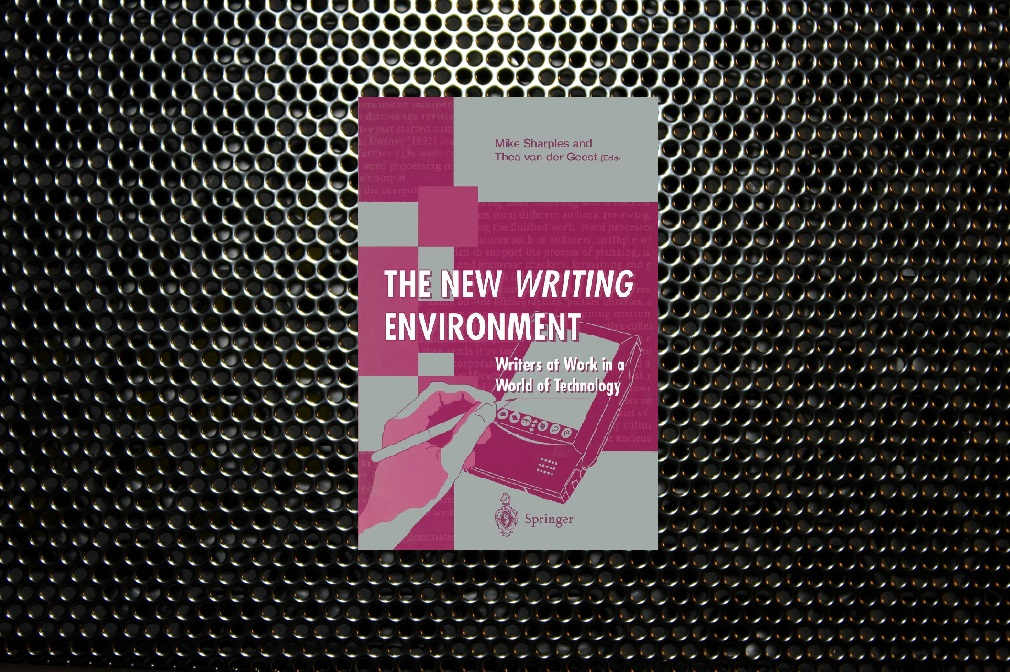

The New Writing Environment (1996) works now as a historical record of the precise moment when the foundations of writing, thought, and authorship first began to shift. The worries it voices about focus, ownership, and identity were not solved by later technological progress, they were built into the system.
There is something strange about returning to a scholarly text on writing technology published nearly three decades ago and finding that its central concerns have not been resolved, only maybe made worse. Apparently, some things change, some things never do.
The New Writing Environment: Writers at Work in a World of Technology (1996) is a collection of academic articles, edited by Mike Sharples and Thea van der Geest. It arrived at a peculiar turning point: the moment when the word processor had become normal but the networked world had not yet invaded every corner of the writer's attention (Kruse & Rapp, 2023, p. 16). The book captures, with perfect accuracy, a mind in the middle of a deep change, and that change, it turns out, was only the first shake of a much longer earthquake.
The volume brings together research studies, cognitive science frameworks, and close observations of professional writers navigating the shift from analog to digital tools. Its academic tone is careful and occasionally dry. At the same time, with all its academic rigor and the seemingly outdated references, the read turns out to be a vigorous reminder, blast from the past - in hindsight, a mirror of our present human condition in the age of hypertext.
The Cognitive Break of the Digital Hand #
One of the book's most lasting contributions lies in its examination of what happens to thought when the hand stops dragging ink across paper. Sharples and his contributors argue, drawing on then-emerging cognitive science, that the physical act of writing by hand is not merely a way of recording thought – it is a way of generating it (Sharples & Thea, 1996, p. 99). This position connects directly to the foundational work of Flower and Hayes (1981, p. 373), whose cognitive model of writing established that composition is not a straight line from thought to page, but a back-and-forth process in which the act of writing itself creates meaning.
The resistance of the page, the permanence of the pen stroke, the physical memory built up through handwriting: these are not small details but core parts of how ideas take shape. When writers moved to screens, they did not simply adopt a faster typewriter. They entered a genuinely different mental environment, one that Anne Mangen and Jean-Luc Velay have described in terms of the sensory loss that comes with digital writing, arguing that the feel of the hand on paper creates memory in the body that helps both the creation and retention of text (Mangen & Velay, 2010, p. 395).
Connectivity, Focus, and the Interrupted Mind #
The book's treatment of connectivity and mental focus is, in my opinion, its most far-sighted and, at the same time, its least developed section. The contributors note, carefully and cautiously, that access to information networks during the writing process brought new patterns of interruption (Sharples & Thea, 1996, p. 113). Those patterns did not only include outside disturbances, but self-generated ones, as writers began reaching for the network (Sharples & Thea, 1996, p. 78) the way an earlier generation might have reached for a dictionary. What the text identifies as a new behavioral pattern, we now somehow recognize as the defining mental condition of knowledge work in our time.
Nicholas Carr, in The Shallows: What the Internet Is Doing to Our Brains (2010), would later make this argument clear, drawing on brain science to suggest that continued internet use rewires how we pay attention; shrinking the capacity for deep, sustained reading and writing in favor of fast, jumping-around browsing (Carr, 2010, p. 78).
Sharples and van der Geest were watching the first sparks of this fire.
What the book taught me about Content Strategy #

Content strategy is all about planning and reuse. My journey reading this book was enriched by the benefit of hindsight, allowing its ideas to be easily discovered by me and stand the test of time like fine wine. This experience taught me to always look back and plan based on the work of our predecessors. This applies not only to day-to-day operations, but also to broader philosophical ideas and holistic approaches, in content and in life generally.
The Virtual Workspace and the Shifting Professional Identity #
I would like to argue that the sections about “virtual workspace” are, looking back, the most philosophically rich. They describe early experiments in remote writing environments; writers working from different locations, sharing documents, building texts together without sharing physical space (Sharples & Thea, 1996, p. 98). The underlying assumption in much of this analysis is that the workspace is a neutral container that shapes habits but not identity (Sharples & Thea, 1996, p. 57). I think that assumption does not hold up.
Jay David Bolter, in Writing Space: The Computer, Hypertext, and the History of Writing (1991), had already argued that the electronic writing space was not just a new medium but a new way of understanding what a text even is (Bolter, 2011, p. 11), one that fundamentally changed the writer's relationship to authority, order, and ownership (Bolter, 2011, p. 30).
Richard Lanham made a similar case in The Electronic Word (1993), contending that the natural instability of digital text dissolved the stable, clear identity of the literary work and, with it, its author (Lanham, 1993, p. 77 & 143).
The professional writers in Sharples and van der Geest's studies – technical communicators, corporate writers, academics – drew their sense of professional self partly from the physical habits surrounding their work: the office, the desk, the paper. As those anchors disappeared into the virtual, something more than convenience was rearranged (Sharples & Thea, 1996, p. 98). The professional identity of the writer became, like their documents, something that lived on a server; available to others, transferable, and ultimately unstable.
Old Book, Open Wound #
To call this text “dated” is to miss the point. Its age is exactly what makes it valuable. The New Writing Environment works now as a historical record of the precise moment when the foundations of writing, thought, and authorship first began to shift. The worries it voices about focus, ownership, and identity were not solved by later technological progress, they were built into the system. Shoshana Zuboff's concept of “surveillance capitalism,” developed in her 2019 study, would eventually describe where this road leads: a world in which the writer's every keystroke becomes data, collected and turned into profit by the very platforms that now make up the environment in which writing happens (Zuboff, 2019, p. 127 [ePub]). For example, Microsoft owns a lot of the devices writers use, and owns LinkedIn, the platform a lot of professionals use to write or communicate; controlling nearly every modern writing environment.
The book's contribution to the study of writing and technology is therefore less as a final answer than as an early warning system. It picked up the first signals accurately. That we are still living with those signals – louder now, and harder to escape – is not its failure. It is, if anything, its most uncomfortable proof of relevance.
References #
Bolter, J. D. (2011). Writing space: computers, hypertext, and the remediation of print. Routledge.
Carr, N. (2010). The Shallows: What the Internet Is Doing to Our Brains. W W Norton.
Flower, L., & Hayes, J. R. (1981). A Cognitive Process Theory of Writing. College Composition and Communication, 32(4), 365–387. https://doi.org/10.2307/356600
Kruse, O., Rapp, C. (2023). Word Processing Software: The Rise of MS Word. In: Kruse, O., et al. Digital Writing Technologies in Higher Education. Springer, Cham. https://doi.org/10.1007/978-3-031-36033-6_2
Lanham, R. A. (1993). The electronic word: democracy, technology, and the arts. The University Of Chicago Press.
Mangen, A., & Velay, J.-L. (2010). Digitizing literacy: Reflections on the haptics of writing. In M. H. Zadeh (Ed.), Advances in haptics. InTech.
Sharples, M., & Thea. (1996). The New Writing Environment. Springer Science & Business Media.
Zuboff, S. (2019). The age of surveillance capitalism: The fight for a human future at the new frontier of power. PublicAffairs.