



Artificial intelligence has rapidly become part of how organizations communicate, make decisions and shape their public presence. For students, professionals and anyone working in content strategy, this shift raises an important question: Do we actually understand the systems we increasingly rely on?
The discussion around AI literacy builds on earlier concepts such as media literacy and digital literacy. These approaches traditionally focused on understanding, critically evaluating and responsibly using media and digital technologies. As artificial intelligence increasingly shapes how information is created, filtered and distributed, these competencies need to be extended. AI literacy responds to this development by focusing specifically on artificial intelligence - its logic, its limitations, and its societal and organizational impact.
This is where AI literacy comes in - not as a buzzword, but as an essential capability for navigating today’s communication landscapes.
During our recent study block, we explored this topic in depth and even facilitated a short, student-led workshop on AI literacy. It sparked discussions that went far beyond tools or prompt crafting. The central insight was simple: Strategic communication now requires the ability to understand AI, use it effectively and reflect critically on its impact.
What AI Literacy Really Means #
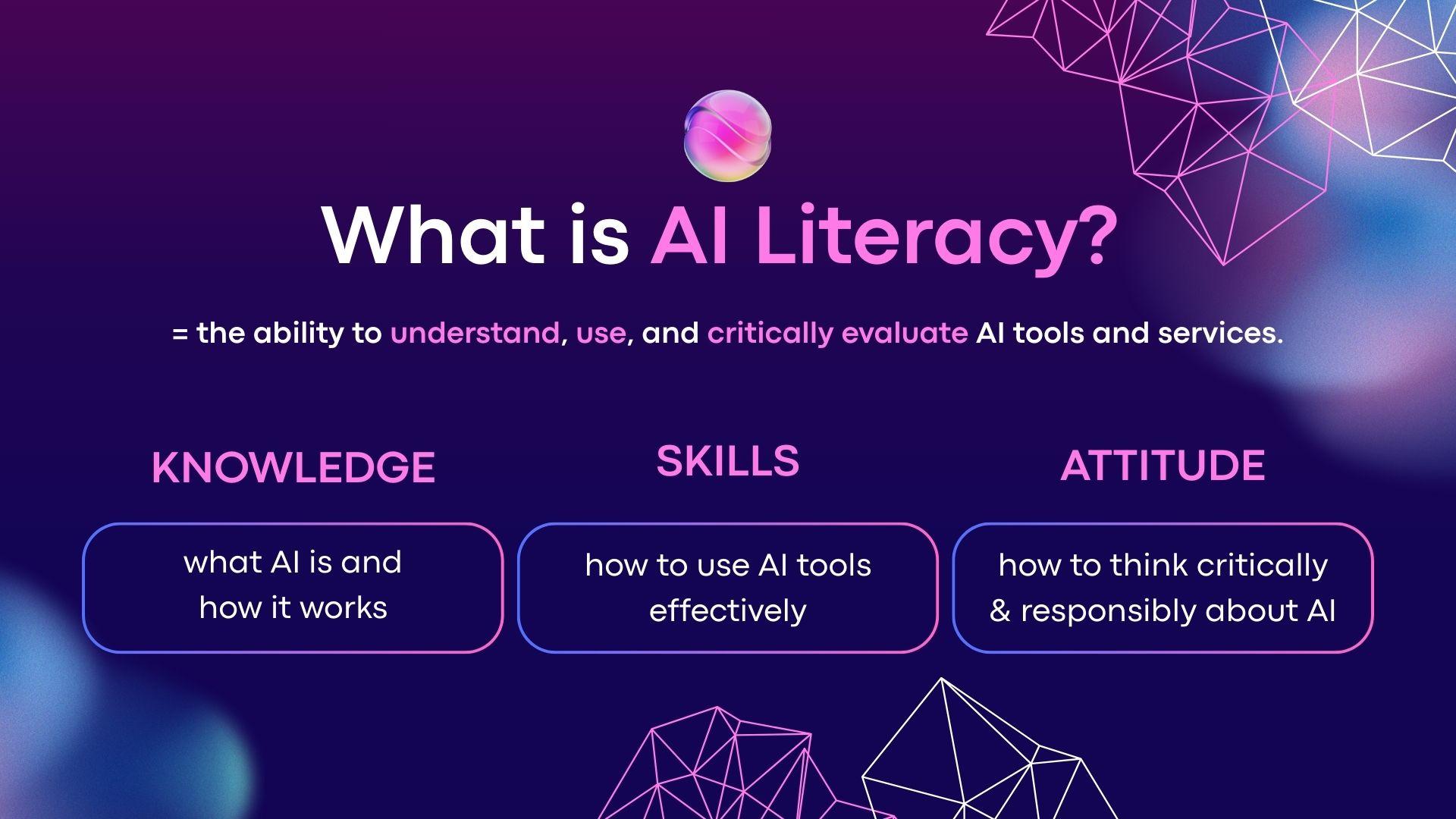
AI literacy can be understood through three interconnected dimensions:
1. Understanding what AI is and how it works
Communicators don’t need to become programmers, but they do need a basic awareness of how AI systems generate text, classify information or recommend solutions. Knowing that these systems rely on patterns, probabilities, and training data (ot “facts” or “intent”) helps us use them responsibly.
2. Using AI tools effectively
From drafting ideas to structuring research, AI tools can support creative and strategic work. But effectiveness depends on skill: clear instruction, context, constraints and thoughtful review. Without this skill, outputs remain generic, biased or misleading.
3. Thinking critically and ethically about AI
AI literacy is also an attitude. It involves questioning accuracy, spotting inconsistencies, understanding limitations, recognizing bias and considering ethical implications. For communicators who shape narratives and influence organizational decisions, this reflective mindset is essential.
Together, these dimensions form a foundation for responsible and strategic use of AI.
Why AI Literacy Matters in Strategic Organizational Communication #
Strategic Organizational Communication is fundamentally about how organizations create meaning, build relationships and navigate complex environments. As AI becomes woven into everyday communication processes, it interacts with all of these dimensions - sometimes by empowering communicators, sometimes by adding new layers of challenge.
AI literacy therefore becomes indispensable for anyone working in this field. Communicators face an increasing flood of information, and while AI tools can help structure and interpret data, this only works when users know how to guide, verify and critically synthesize the results.
AI also shapes both internal and external communication flows: automated writing assistants, analytics systems, and generative tools influence how messages are produced, adapted, and shared. To maintain clarity and consistency across channels, communicators need to understand how these systems operate and where their limitations lie.
At the same time, trust and credibility depend on the responsible use of AI. Stakeholders expect accuracy, transparency and thoughtful judgment, especially when automated systems are involved in content creation or decision-making. This becomes even more important as AI introduces new ethical challenges, from misinformation and synthetic imagery to biased outputs or opaque recommendation processes. Communicators play a central role in evaluating these risks and ensuring that their organizations act responsibly.

Although AI can support research, ideation and production, strategic thinking itself remains deeply human.
AI-literate communicators understand when automation can be helpful - and when human insight, creativity and ethical reflection are essential.
Assess Your Own AI Literacy #
If you would like to understand where you currently stand, there is a freely accessible self-assessment tool that evaluates your knowledge, skills and attitude toward AI:
AI Literacy Self-Assessment Test: https://www.comm-ait.com/en
It only takes a few minutes and can help you identify personal areas for growth.
AI Literacy as a Skill Set for the Future #
The more AI becomes integrated into communication work, the more valuable it becomes to build a strong literacy around it. Not to master every tool, but to:
- understand the capabilities and limits of AI
- reflect critically on outputs
- integrate AI into workflows with purpose
- maintain ethical and strategic responsibility
For students of content strategy, AI literacy is not an isolated topic - it is tied directly to our professional identity. For practitioners, it is a growing expectation. And for anyone entering the field, it offers a chance to shape how organizations communicate in the future.
Conclusion #
AI is reshaping the communication landscape, but strategic thinking remains fundamentally human. AI literacy gives communicators the confidence to use new tools without losing sight of their responsibilities. It sharpens our ability to make meaning, guide organizations, and communicate with clarity in increasingly complex environments.
Whether you’re a current student, a professional, or someone simply curious about the future of communication: AI literacy is one of the most important skills you can develop today.
Where to go from here #
The Tragedy of the Attention Commons and the Crisis of Communication
Language Awareness in Corporate Communications: From Unconscious Wording to Inclusive Content
References #
The lecture Strategic Organisational Communication, taught by Lisa Dühring, was part of the Content Strategy Program at FH Joanneum during the Winter Semester 2025.