

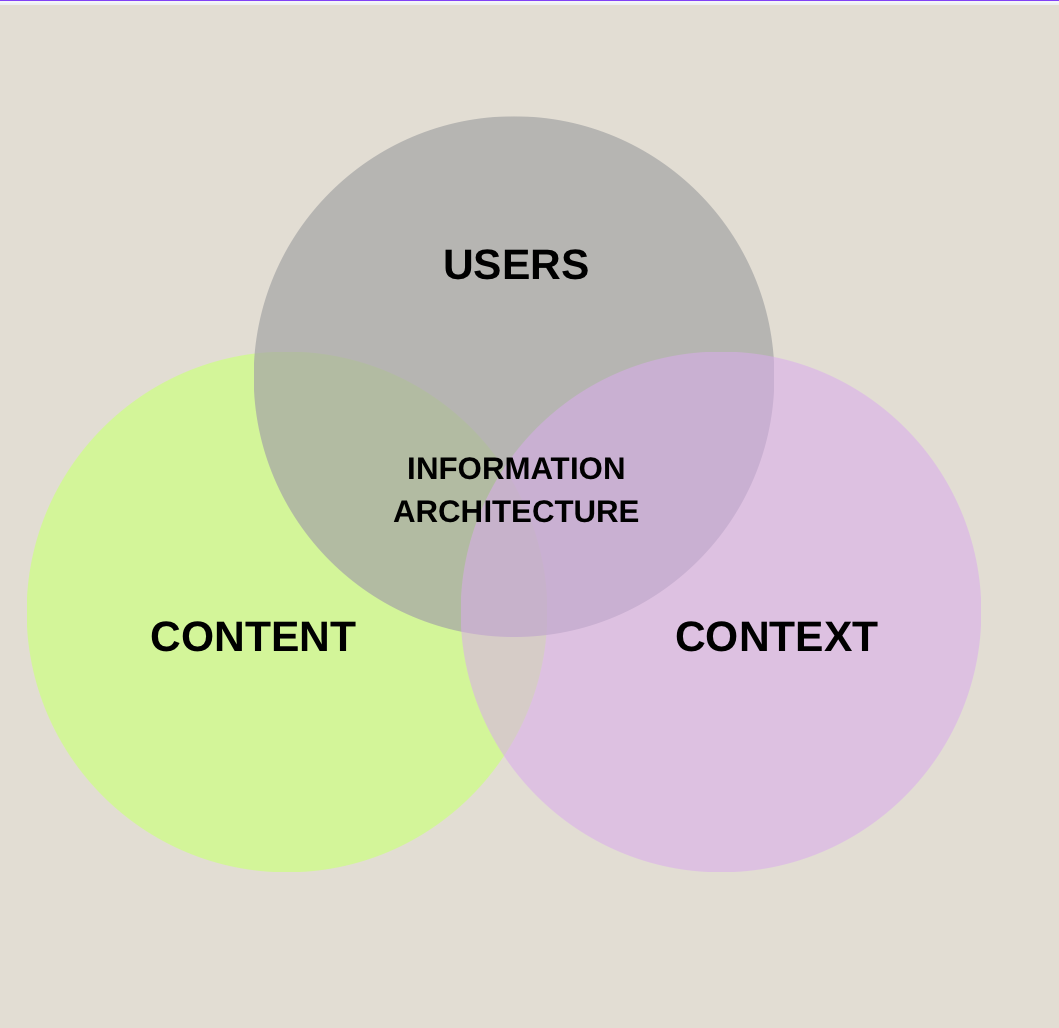
 Information architecture is evolving as AI and LLMs become new consumers of digital information. Websites should now support both human navigation and machine interpretation through clear labels, structured content, meaningful metadata, consistent terminology, and explicit relationships. Good IA helps both people and AI agents find, understand, and connect information effectively.

As AI and LLMs increasingly mediate access to digital information, websites need to be structured for both people and AI systems. Clear organisation, consistent terminology, and connected information help AI agents interpret and retrieve content more effectively.
Information architecture (IA) is traditionally understood as the practice of organising, structuring, and labelling information so that people can find and understand it efficiently. On a website, this includes decisions about navigation menus, categories, page structures, labels, search functions, and relationships between different pieces of content. Good information architecture allows users to understand where they are, what information is available, and how they can reach the information they need.
However, the role of information architecture is changing as people increasingly access information through large language models (LLMs) and AI agents. Users no longer necessarily need to visit a website, browse its navigation menu, and read individual pages. Instead, they may ask an AI system to find information, compare several sources, or complete a task on their behalf. This creates a new question for information architecture: how should information be organised when the user may be either a human navigating the interface or an AI system retrieving and interpreting the content?
Information Architecture for Human Users
Traditional information architecture is closely connected to usability. People do not process websites as databases; they interpret visual structures, language, categories, and relationships. A well-designed website therefore needs to reflect the way users expect information to be organised.
For example, consider a film festival website. A visitor may want to know when the festival takes place, which films are being shown, where screenings are located, and how to purchase tickets. If this information is scattered across unrelated pages, the user has to spend additional time searching for it. A smaller festival showing 20 films, for instance, might organise its website into a few sections such as Festival, Programme, Films, Venues, Tickets, and About, while a larger festival showing 200 or 500 films may require more detailed categorisation and filtering within these sections. Within the Programme section, films could therefore be organised by date, genre, country, or screening location, depending on the amount and type of information users need to navigate.
This structure creates relationships between pieces of information. A film can be connected to its director, screening date, venue, and ticket page. These relationships help users understand the content and move through the website without unnecessary effort.
Traditional IA therefore involves several interconnected elements: organisation systems determine how information is grouped, labelling systems determine how categories are named, navigation systems help users move between parts of the website, and search systems allow users to retrieve specific information. Metadata can provide additional information about individual pieces of content and help establish relationships between them.
When AI Becomes an Information Consumer
The increasing use of LLMs and AI agents changes this process. An AI system does not experience a website in exactly the same way as a human visitor. A person can visually recognise that a large heading refers to an event date and that a button labelled “Buy tickets” represents an action. An AI system instead needs to interpret the underlying digital information and determine what different pieces of content represent and how they relate to each other.
This makes the structure of information increasingly important. Consider a simple festival announcement:
Film Festival
15 - 20 August 2026
Kyiv, Ukraine
Tickets available now
A human user can understand this information immediately. An AI agent, however, may need to identify that “Film Festival” is an event, “15 - 20 August 2026” represents its date, and “Kyiv, Ukraine” represents its location. It may also need to determine where tickets can be purchased and whether the information is current.
This does not mean that AI requires an entirely different type of information architecture. Rather, it makes existing principles such as clear labelling, consistent terminology, explicit relationships, metadata, and structured information even more important. When information is clearly organised, both humans and computational systems have a better chance of identifying its meaning.
From LLMs to AI Agents
The distinction between LLMs and AI agents is particularly relevant to information architecture. An LLM primarily processes and generates language, while an AI agent can use information to perform tasks. An agent may search different websites, retrieve information, compare alternatives, and potentially take actions based on a user's request.
For example, instead of visiting a film festival website, a user might ask an AI agent:
“Find a film festival in Ukraine in August, check the programme, and tell me which films are being screened”
The agent would need to locate relevant information, understand dates and locations, identify films and their relationships to the festival, and distinguish current information from outdated information. If the festival's website contains inconsistent dates, unclear labels, duplicated information, or disconnected pages, the agent may have difficulty producing an accurate answer.
This creates a new role for information architecture – making information discoverable, interpretable, and retrievable by systems that act as intermediaries between users and websites. This shift reflects the broader evolution from traditional Search Engine Optimisation (SEO) towards Answer Engine Optimisation (AEO) and Generative Engine Optimisation (GEO), where the goal is increasingly not only to help websites rank in search results, but also to make their content accessible and understandable to systems that generate answers for users.
Designing for Two Audiences
This development suggests that digital products increasingly have two audiences: human users and LLMs. The two audiences interact with information differently, but many of the principles that support one also support the other.
For human users, a festival website should have understandable labels, intuitive navigation, logical categories, and clear visual hierarchy. For AI systems, the same website benefits from consistent terminology, explicit relationships between pieces of information, meaningful metadata, structured content, and clear indications of what different pieces of information represent.
This does not mean that websites should be designed primarily for AI. Optimising a website only for machine interpretation could make the human experience more complicated or less accessible. Instead, the goal should be to create information structures that are clear enough for people to understand while also being sufficiently explicit and consistent for computational systems to interpret.
The Importance of Content Relationships
One of the important changes brought by AI is the growing importance of relationships between individual pieces of content. Traditional websites often treat pages as separate destinations. In an AI-mediated environment, however, information may need to be understood as a network of connected entities.
For a film festival, a single film could be connected to its director, actors, country of production, genre, screening time, venue, festival edition, and ticket information. A user might enter the website through any of these points, while an AI agent might retrieve only a specific piece of information in response to a question.
Clear relationships make this information more useful. If the connection between a film and its screening date is explicit, an AI agent can more easily answer a question such as “What films are being shown on Saturday?” If the relationship between a venue and its screenings is clear, the system can potentially answer “Which films are being screened at Kino Hall 2?”
In this sense, good information architecture can support not only navigation but also information retrieval and contextual understanding.
Challenges for Information Architecture
Designing information architecture in an AI-driven environment also creates several challenges. One is the problem of outdated information. A website may contain a festival programme from a previous year alongside information about the current festival. A human may recognise the difference from the page design or context, while an AI system may retrieve information from both sources if the dates and labels are unclear (for now).
Another challenge is inconsistency. If one page refers to “Film Festival,” another uses “Cinema Festival,” and another uses an abbreviation, both users and AI systems may have more difficulty identifying whether the pages refer to the same entity.
Fragmented information creates a similar problem. If the date of an event is on one page, its location on another, and ticket information somewhere else without clear connections between them, an AI agent may not reliably combine these pieces of information.
Therefore, effective IA increasingly requires attention to consistency, currency, relationships, and context, rather than simply deciding where pages should appear in a navigation menu.
Conclusion
Information architecture remains a fundamental part of digital design, but its role is expanding. Traditionally, IA has focused on helping humans navigate and find information efficiently. The growth of LLMs and AI agents introduces another type of information consumer that does not interact with websites in exactly the same way as people.
As AI increasingly becomes an intermediary between users and digital content, information architecture must support both human understanding and machine interpretation. Clear labels, logical categories, structured information, meaningful metadata, and explicit relationships between content can improve the experience for human users while also making information easier for AI systems to retrieve and interpret.
In my opinion, the future of information architecture is not about choosing between designing for humans or designing for AI. Instead, it is about creating clear and connected information environments that can serve both.
Where to go from here #
Mapping the Chaos: Introduction to Content Ecosystem Maps
References #
Guha, R. V., Brickley, D., & MacBeth, S. (2015). Schema.org: Evolution of structured data on the web. Queue, 13(9), 10–37. https://doi.org/10.1145/2857274.2857276
Rosenfeld, L., Morville, P., & Arango, J. (2015). Information Architecture: For the Web and Beyond.
The lectures take place in a second semester of COS25, from 20th of May till the end of the semester. Lecture held by Lief Erickson, information architecture lecturer and a member of the COS17 cohort.