


 This article explores the extent to which content strategy maturity models can serve as strategic steering tools and under what conditions they reach their conceptual and organizational limits.



Maturity models help organizations transform fragmented, reactive content tasks into professional, governed systems while providing a roadmap to balance operational efficiency with creative flexibility.
1. Introduction
Content strategy has become increasingly complex as organizations expand their digital presence across platforms, teams, and markets. Once primarily an editorial discipline, it now includes governance, workflows, and long-term coordination. To address this complexity, maturity models from process and quality management have been adapted to show how content practices develop over time, guiding organizations from ad hoc activities to coordinated, sustainable systems.
For content strategists, the challenge is no longer only creating effective content but designing systems that ensure consistency, scalability, and continuous improvement. These models are also applied in education, such as in FH Joanneum’s Content Strategy program, where courses like Change Management and Internal Communication, taught by Rahel Bailie, introduce frameworks for implementing strategy in real organizations.
2. Content Strategy Maturity Model
Maturity models are often mistaken for simple scoring tools, but they are frameworks for understanding how an organization’s content capabilities develop over time. Rather than measuring “how good” a team is, they show how ways of working evolve, with each stage building on the last.
The model reflects a common pattern: teams often start with reactive, ad hoc approaches and gradually move toward coordinated, stable, and self-improving practices. This way of thinking is not new. It draws on research from developmental psychology (e.g. Jean Piaget), organizational learning (e.g. Chris Argyris), and process improvement frameworks like the Capability Maturity Model. Across these fields, the common insight is that development follows recognizable patterns rather than happening randomly.
For content teams, the maturity model provides a lens for reflection and planning. It helps organizations see where they currently stand, understand typical patterns of growth, and make informed decisions about practical next steps. In essence, it is less about judging performance and more about supporting evolution and sustainable capability building.
2.1 Stages
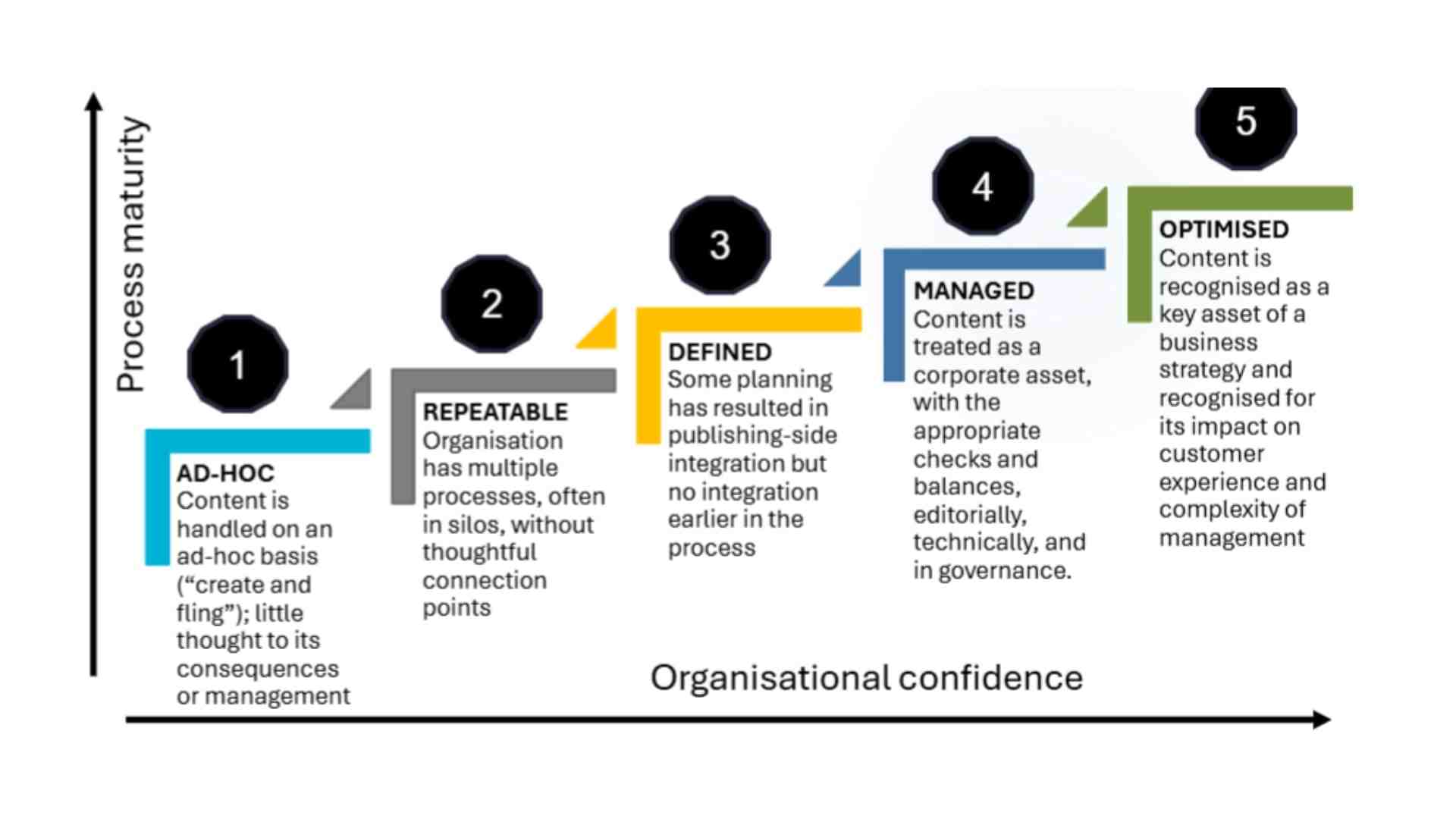
Content maturity models follow a staged logic that describes how organizations evolve from unstructured, reactive content practices to strategically governed, optimized ecosystems. While terminology varies slightly across models, a widely accepted progression includes five core stages:
2.1.1 Ad-hoc
At this initial stage, content is created in a fragmented and reactive manner. There is little to no overarching strategy, governance, or documentation. Content decisions are driven by immediate needs rather than long-term goals. Responsibilities are unclear, and success is rarely measured systematically.
2.1.2 Repeatable
Organizations begin to establish basic processes and routines. Certain content activities (e.g., publishing blog posts or newsletters) become more consistent. However, these processes are often siloed and dependent on individuals rather than institutionalized practices. Early attempts at standardization emerge, but strategy remains implicit.
2.1.3 Defined
At this stage, content strategy becomes explicit. Organizations document workflows, define roles, and align content efforts with business objectives. Governance structures start to form, and content guidelines (tone of voice, formats, channels) are introduced. Cross-functional collaboration improves, although execution may still lack full integration.
2.1.4 Managed
Content is now treated as a measurable and controllable asset. Organizations implement KPIs, analytics, and performance frameworks to evaluate effectiveness. Decision-making becomes data-informed, and content operations are actively managed across channels. Governance is enforced, and continuous improvement processes are introduced.
2.1.5 Optimized
In the most advanced stage, content strategy is fully embedded in the organization’s strategic core. Processes are continuously refined through data, experimentation, and user insights. Personalization, automation, and scalability play a central role. Content is no longer just a communication tool but a driver of customer experience and business value.
2.2 Criteria
To assess where an organization falls within these stages, maturity models rely on a set of evaluation criteria. These criteria function as diagnostic dimensions rather than isolated metrics, offering a holistic view of content capabilities.
2.2.1 Strategy & Alignment
Examines whether content activities are aligned with overarching business goals. This includes the presence of a documented content strategy, clearly defined objectives, and integration with marketing, product, and brand strategies.
2.2.2 Governance & Processes
Focuses on the existence and maturity of workflows, roles, and responsibilities. Key indicators include editorial planning, approval processes, and cross-team coordination. Mature organizations demonstrate consistency and scalability in their operations.
2.2.3 People & Culture
Assesses the human and organizational aspects of content work. This includes skill sets, role clarity, collaboration culture, and leadership support. A mature organization fosters shared ownership of content and promotes strategic thinking beyond individual silos.
2.2.4 Technology & Infrastructure
Evaluates the tools and systems used to create, manage, and distribute content. This ranges from basic CMS usage to integrated content ecosystems, including automation, personalization engines, and analytics platforms.
2.2.5 Measurement & Optimization
Looks at how performance is tracked and used. Early stages may rely on vanity metrics, while advanced stages implement robust KPI frameworks tied to business outcomes. Continuous optimization through testing and insights is a hallmark of higher maturity.
2.2.6 Customer-Centricity
Assesses the degree to which content is designed around user needs and journeys. Mature organizations base their content decisions on audience research, data, and feedback loops, ensuring relevance and value at every touchpoint.
3. Application to Content Strategy
Content maturity models become valuable when used as practical steering tools rather than theoretical frameworks. Their primary function is to make an organization’s content capabilities visible and actionable.
3.1 They enable structured self-assessment.
By mapping current practices against defined stages and criteria, organizations can quickly identify gaps, inefficiencies, and blind spots.
3.2 They support strategic prioritization.
Instead of isolated improvements, maturity models help define clear development paths, highlighting which capabilities (e.g., governance, measurement, or technology) need to evolve next.
3.3 They strengthen stakeholder communication.
The staged logic translates complex content challenges into a clear narrative, making it easier to align teams, justify investments, and position content as a strategic function.
Note that maturity models should be applied flexibly. They are not rigid benchmarks, but orientation tools that must be adapted to the organizational context. Their value lies in guiding continuous development, not in reaching a fixed “final stage.”
4. Practical Implications for Content Strategists
For content strategists, content maturity models enable them to diagnose current states, define realistic development paths, align stakeholders, and implement scalable processes. Yet their effectiveness depends on how they are applied: as flexible, context-sensitive tools rather than prescriptive frameworks.
4.1 Diagnostic Assessment and Capability Mapping
A primary application of maturity models is structured self-assessment. By evaluating current practices and criteria, content strategists can develop a clear understanding of organizational strengths and weaknesses. This process usually involves content audits (inventory, quality, consistency), stakeholder interviews across departments, and workflow and governance analysis. It can then lead to a capability map that highlights gaps. For example, strong content production but weak governance, or advanced tooling but limited strategic alignment.
In fact, industry guidelines from the Content Marketing Institute emphasize that such audits are foundational to building effective and scalable content strategies.
4.2 Strategic Roadmapping and Prioritization
Beyond diagnosis, maturity models enable structured prioritization of initiatives. Rather than pursuing isolated improvements, strategists can define a coherent development path aligned with their current maturity stage.
For instance, organizations in the “ad-hoc” or “repeatable” stages should prioritize foundational elements such as role definition and workflow standardization. Meanwhile, organizations in the “defined” stage may focus on governance frameworks and cross-functional alignment. More mature organizations can invest in optimization, personalization, and automation
This staged approach prevents premature investments (e.g., advanced technology without governance) and ensures that development efforts are both realistic and impactful.
4.3 Stakeholder Alignment and Communication
One of the most practical advantages of maturity models is their ability to translate complexity into a shared language.
While content strategy often suffers from a lack of visibility and understanding within organizations, maturity models address this by framing content challenges in structured, non-technical terms; providing a narrative of progression (“where we are” vs. “where we need to go”); and supporting communication with leadership and non-content stakeholders.
This aligns with the work of Kristina Halvorson, who emphasizes the importance of clarity and alignment in establishing content as a strategic function. As a result, maturity models can significantly improve cross-functional collaboration, particularly between marketing, UX, product, and engineering teams.
4.4 Resource Allocation and Business Case Development
Content maturity models also play a critical role in justifying investment and resource allocation.
By linking maturity gaps to tangible business risks, content strategists can build stronger, evidence-based arguments for hiring specialized roles (e.g., content designers, strategists), investing in technology, and establishing governance structures.
For instance, inconsistent content caused by weak governance can be framed as a risk to brand equity, customer trust, and conversion rates. In this way, maturity models help reposition content from a cost center to a strategic business asset.
4.5 Operational Integration and Process Design
Another key implication lies in the design and optimization of content operations. Maturity models provide a blueprint for structuring workflows, including editorial planning and content calendars, approval and review processes, and cross-channel coordination.
As organizations progress toward the “managed” stage, these processes become increasingly standardized and scalable. Importantly, this operational perspective reinforces the idea that content strategy is not just about planning, but about execution at scale.
4.6 Continuous Improvement and Organizational Learning
Finally, maturity models support the development of a continuous improvement mindset. Rather than treating content strategy as a one-off initiative, they encourage regular reassessment of maturity levels, iterative optimization based on performance data, and integration of user feedback and customer insights.
This aligns with broader organizational learning principles, where capabilities evolve through cycles of evaluation, adaptation, and refinement.
However, this iterative logic must be balanced with critical reflection to avoid over-reliance on structured models.
5. Alternative Perspectives & Limitations
While content maturity models provide valuable structure, their application in practice reveals several conceptual and operational limitations. These limitations are important to consider to avoid over-reliance on what are ultimately simplified representations of complex organizational realities.
5.1 Linear Progression vs. Organizational Reality
A core assumption of most maturity models is that organizations evolve through clearly defined, sequential stages. However, empirical observations suggest that content capabilities are rarely in such a linear fashion.
Organizations often display hybrid maturity states. For example, a company may operate at a “managed” level in terms of measurement and analytics, while simultaneously remaining “ad-hoc” in governance structures. This uneven development challenges the staged logic and reduces the diagnostic precision of the model.
From a theoretical perspective, this critique aligns with the work of Henry Mintzberg, who argues that strategy formation is often an emergent process rather than a planned one. In this sense, maturity models risk oversimplifying the inherently non-linear and iterative nature of organizational development.
5.2 Context Insensitivity and One-Size-Fits-All Logic
Another limitation lies in the generalized nature of maturity frameworks. Most models are designed to be broadly applicable across industries and organizational sizes, which can dilute their practical relevance.
Maturity models are intended to function as flexible steering tools, but without contextual adaptation, they may lead to misleading conclusions. For instance, a startup may deliberately operate with minimal governance to maintain agility, or a highly regulated industry (e.g., finance or healthcare) may require advanced governance even at early stages.
This highlights a key tension: what constitutes “maturity” is not universal but contingent on business models, risk tolerance, and organizational goals.
Content strategy scholars, such as Kristina Halvorson, emphasize that effective content strategy must be tailored to organizational context, reinforcing the idea that maturity models should be interpreted, not applied mechanically.
5.3 Over-Standardization vs. Creative Practice
While process, governance, and standardization are essential for scalability, they can inadvertently constrain creativity. Content is not purely an operational output; it is also a creative and interpretive practice. That’s why excessive formalization may lead to rigid workflows that slow down innovation; overly standardized messaging that lacks authenticity; and reduced autonomy for content creators.
This creates a paradox: the same structures that enable consistency and efficiency may also limit differentiation and emotional resonance. In this regard, maturity models risk privileging operational excellence over creative effectiveness, which is an imbalance that can weaken long-term brand value.
5.4 Measurement Bias and the Limits of Quantification
When an organization progresses toward the “managed” and “optimized,” there is an increasing emphasis on data-driven decision-making. This shift is generally beneficial, but it introduces a significant limitation: not all aspects of content performance are easily measurable.
Common risks include over-reliance on vanity metrics (e.g., page views, clicks), underestimation of qualitative outcomes such as trust, brand perception, or thought leadership, and short-term optimization at the expense of long-term strategic value.
The Content Marketing Institute consistently highlights the challenge of linking content performance to business outcomes, particularly in complex customer journeys. This suggests that maturity models may inadvertently reinforce a bias toward what can be measured, rather than what truly matters.
5.5 Illusion of Finality and Static “Optimization”
The concept of an “optimized” final stage implies a state of completion. However, in dynamic digital environments, such a state is inherently unstable. Technological advancements, evolving user expectations, and shifting platform ecosystems continuously redefine best practices. As a result, today’s “optimized” organization may become outdated tomorrow and continuous adaptation becomes more important than stage progression.
This limitation underscores a critical point that maturity models should guide ongoing development, not define a fixed endpoint.
5.6 Instrumentalization vs. Critical Reflection
Finally, there is a broader methodological concern: maturity models can become over-instrumentalized. When used primarily as benchmarking or reporting tools, they may encourage performative compliance rather than meaningful change; reduce complex strategic questions to checklist-based assessments; and/or oversimplify organizational challenges into predefined categories.
To remain effective, maturity models must be used critically, as interpretive frameworks that support reflection, rather than prescriptive systems that dictate action.
6. Conclusion
Content maturity models are useful, but only up to a point. They give structure to something that often feels messy and hard to define. They help teams step back, see where they are, and figure out what needs to happen next. In that sense, they do exactly what they promise: make content strategy more visible, more tangible, and easier to manage.
But real organizations don’t move in neat stages. Progress isn’t always linear, and “maturity” doesn’t look the same everywhere. What works for one company might be completely wrong for another. And sometimes, the push for structure can even get in the way of creativity and good judgment.
So the value of maturity models lies in how you use them along the way. They’re most helpful when treated as a guide, not a rulebook. For content strategists, that means staying flexible. Use the model to ask better questions, not just to get answers. Combine it with real-world context, team dynamics, and a bit of intuition.
Because at the end of the day, a good content strategy is about being aware enough to know what matters and adaptable enough to keep moving.
Where to go from here #
Mapping the Chaos: Introduction to Content Ecosystem Maps
References #
Content Marketing Institute. (2023). B2B content marketing benchmarks, budgets, and trends. https://contentmarketinginstitute.com
DataGuard. (2024, June 3). What is a capability maturity model (CMM)? https://www.dataguard.com/blog/what-is-a-capability-maturity-model-cmm/
Halvorson, K., & Rach, M. (2012). Content strategy for the web (2nd ed.). New Riders.
Psychology Town. (2025, September 13). Jean Piaget’s cognitive development theory: Stages and processes. https://psychology.town/developmental/jean-piaget-cognitive-development-stages-processes/
Robinson, V. M. J. (2014). Single- and double-loop learning. In D. C. Phillips (Ed.), Encyclopedia of education theory and philosophy (Vol. 2, pp. 747–751). SAGE Publications. https://doi.org/10.4135/9781483346229.n328
Internal Communciation & Change Management 2026 by Rahel Bailie