

 This article builds on concepts introduced in the class Business Strategy for Digital Markets taught by Dieter Rappold. Expanding beyond the classroom discussion, it explores the Customer 1.0 - 5.0 framework by connecting it to content dynamics and the growing influence of emerging technologies on customer behavior and brand communication, highlighting its relevance for today's strategists.


Today’s customers don’t just see brands – they experience them through AI systems, recommendation engines, and online communities that decide what they trust and act on. Understanding Customer 5.0 means thinking beyond traditional messaging and creating content that feels personal, immersive, and part of people’s everyday digital and real-world lives.
For decades, marketing was a one-way street. Companies controlled the message, selected the channels and defined what the public should know about their products and services. Advertising, PR and other communication channels were largely brand-owned territories. Customers listened. Brands spoke.
That dynamic began to change with the rise of the internet, social media and online review platforms. Customers gained a public voice. Ratings, comments and shared experiences started to matter as much as the brand’s own messaging, often even more. Shaping trust shifted away from traditional advertising toward user generated content and influencer opinions. As a result, marketing entered a phase where dialogue mattered more than persuasion and credibility was earned rather than claimed.
This long-term transition can be understood through the Customer 1.0 to 4.0 framework, which illustrates how marketing power gradually moved from brand-controlled messaging to customer-led narratives (Kotler et al., 2010; Kotler et al., 2016). Yet this shift is not the end of the story. We are now entering a new phase, one where influence is no longer guided only by people, but by systems that mediate what people see, trust and decide. This marks the transition toward Customer 5.0, which this article explores in detail.
A Compressed History of Content Power #
Customer 1.0: Product-Driven Content and Brand Authority
In the earliest phase, marketing was product-driven, with a strong focus on producing and selling products efficiently. Customers were primarily seen as buyers with functional needs, and decision-making was assumed to be rational. Content reflected this logic. It focused on features, specifications and availability, delivered through limited media channels in a one-to-many structure fully controlled by brands (Kotler et al., 2010).
Customer 2.0: Emotional Differentiation and Brand Meaning
As markets matured and competition increased, functionality alone was no longer enough. Marketing shifted toward customer orientation, recognizing that people make decisions with both mind and heart. Customers expected relevance and emotional connection. Content evolved accordingly. Storytelling, branding and emotional differentiation became central and communication moved closer to one-to-one relationships (Kotler et al., 2010).
Customer 3.0: Dialogue and Participation
The rise of digital platforms and social media enabled a new wave technology. Customers were no longer passive recipients of messages but active participants in conversations. Marketing evolved toward a human-centric approach, recognizing people as whole human beings with values, beliefs and engagement beyond their needs.
Content became interactive and conversational. Many-to-many communication replaced linear messaging. Brands invited participation, dialogue and encouraged feedback. Trust began to form through engagement rather than exposure. (Kotler et al., 2010)
Customer 4.0 - Customer-Controlled Narratives
With constant connectivity and the digital economy, peer-to-peer communication became dominant. People increasingly trusted opinions from the f-factor (friends, families, fans and followers) more than traditional marketing communications. Content was increasingly created by users themselves, with reviews, user-generated content and influencer opinions becoming credible and the key sources of trust. (Kotler et al., 2016)
Customers collectively defined meaning and content strategy shifted toward facilitation rather than control. While this dynamic still exists today, it is slowly losing influence as new technologies (e.g. AI) change how people find and trust information. This signals the move toward Customer 5.0 (Kotler et al., 2021)
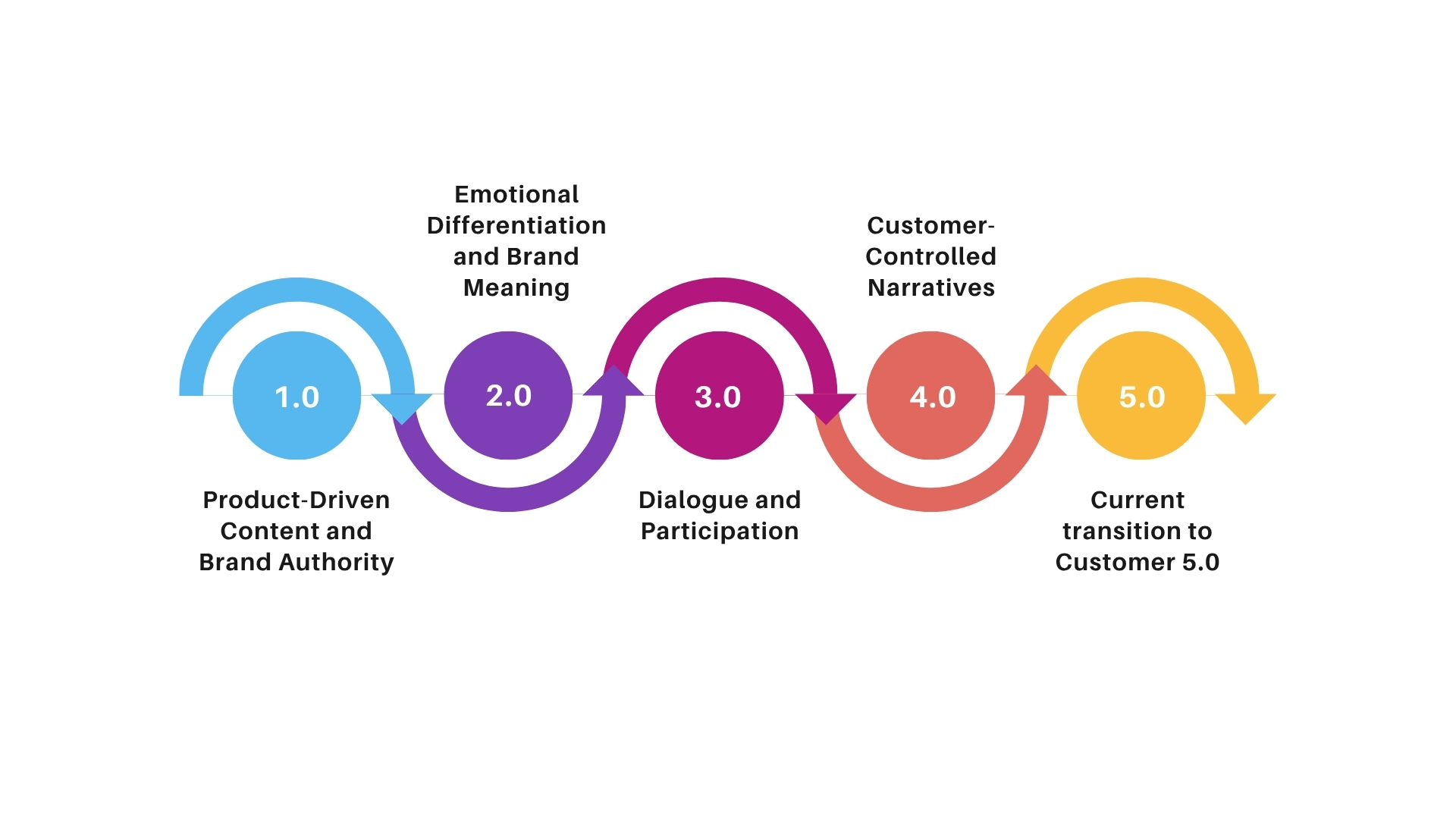
We’re in Transition to Customer 5.0 #
Customer 5.0 describes the next stage in how people relate to brands. It builds on the “Age of the Customer,” where power shifted from companies to consumers. But this stage is different. What makes Customer 5.0 unique is the world around them. In today’s digital society, technology is not separate from human life - it is woven into it.
The new customer is primarily represented by Generations Z and Alpha – digital natives who do not experience technology as a tool but as an extension of their cognitive environment (Kotler et al., 2023). For them, information is not searched manually – it is curated, filtered, summarized and generated.
Search engines, recommendation systems and generative AI have become gatekeepers. They stand between the customer and the brand. When a customer asks a question, AI interprets it, selects sources, compresses them and presents an answer. The brand is no longer speaking directly to a person. It is speaking through a system that interprets it first.
What Leads Customer 5.0?
Customer 5.0 is driven by a mix of maturity and selectivity. Younger consumers adopt adult-like decision patterns earlier - a phenomenon Kotler et al. (2023) described as “Kids Getting Older Younger” (KGOY). They expect brands to demonstrate purpose, ethical behavior and social impact as a baseline, not a differentiator.
At the same time, Customer 5.0 is highly selective in attention. Their engagement is fleeting unless content resonates with their identity or interests. They scroll past irrelevant messages in seconds, yet interact deeply with experiences that feel personally meaningful. Consequently, brands are increasingly evaluated not just by what they sell, but by how they integrate into a larger ecosystem of meaningful experiences.
This expectation drives the demand for hyper-personalized experiences, where digital technology augments physical spaces and virtual worlds simulate reality. Immersive experiences enable younger consumers to interact with content in ways that are both engaging and contextually relevant (Kotler et al., 2023). For Customer 5.0, the brand is successful when it is not only visible but also integrated into the consumer’s lifestyle, values and digital-physical ecosystem.
What This Means for Content Strategy Today #
For Customer 5.0, content is no longer a broadcast. It is immersive, responsive and community-shaped. Short-form, visual and contextual formats dominate because they fit algorithmic logic and human behavior alike. Micro-moments (brief interactions where decisions happen quickly) become strategically important touchpoints.
Nowadays, content must align with behavioral insights and real-time signals to meet audiences before they articulate their desires. And as these expectations evolve, so does the way content reaches those audiences. People are moving away from large, algorithm-driven feeds toward smaller, trusted communities. Discord serves gamers, Reddit threads host niche hobbyists and Patreon connects fans with creators. In these spaces, brands cannot simply advertise. They must participate, contribute and anticipate needs.
Structured data, semantic clarity and authority signals become essential, ensuring that content is AI-readable, retrievable and trusted. As consumption patterns shift, AI assistants, chatbots and voice interfaces now mediate discovery and decision-making. Engagement is increasingly a dialogue between human and machine, which means content must be designed not only for people but also for the systems that interpret and recommend it.
Finally, content must be designed to be inhabited, not just consumed. The convergence of physical and digital experiences (spatial interfaces, augmented layers, interactive environments, virtual showrooms and shoppable streams) is no longer experimental. Early adopters are already exploring immersive digital environments and branded virtual goods.
What Brands Need to Do #
Winning with Customer 5.0 means looking beyond products that serve only function. Companies must deliver complete experiences that reflect customer values, emotions and digital behaviors:
- Technology should handle speed, scale, and personalization. AI can power recommendations, automate support and respond in real time, while AR, VR and immersive digital environments can create interactive experiences.
- Humans should focus on empathy and creativity. When interactions become complex or emotional, a human presence still matters.
- Customer journeys must feel seamless. Discovery, purchase and support should connect smoothly across digital and physical spaces, allowing customers to move naturally from one touchpoint to another.
- Purpose must be visible. Sustainability and social impact should show up in everyday decisions, not just in brand statements.
- Organizations need to stay agile. Teams must test quickly, learn fast and adapt to changing customer needs, including experimenting with new digital immersive content and strategies.
What Winning Brands Are Doing Differently #
An example of a brand adjusting to Customer 5.0 is Nike. Not by simply selling shoes, but by becoming part of people’s lives, digital routines and communities.
Nike’s digital platform strategy turns its own channels into personalized environments. The Nike App, plus Nike Training Club and Nike Run Club, use behavioral data to recommend products, workouts and content tailored to individual preferences, reinforcing relevance in real time rather than generic broadcast messaging (Kumar, 2026). This hyper‑personalization, powered by AI and analytics, strengthens engagement and drives loyalty by making experiences feel uniquely “for you.”
Nike also invites customers to co-create. Its Nike By You platform lets individuals design products that reflect their identity, turning consumers into participants and creators rather than passive receivers.
Immersive experiences are another key. Nike created Nikeland, a virtual world inside Roblox, where users can play, explore and try digital products (Kotler et al., 2023). This goes beyond shopping: it builds community, entertainment and shared experiences that deepen emotional connections.
The lesson is clear: in the era of Customer 5.0, winning brands succeed not by shouting louder. But by becoming part of lives and systems: personalized, participatory and integrated across real and digital worlds.
Conclusion #
Customer 5.0 experiences the world through technology as much as through people, shaping how they discover, trust and engage with brands. Marketing is no longer about messages, but about meaningful, participatory experiences woven into daily life. Brands that succeed design content that is immersive, personalized and aligned with customer values. The future belongs to those who combine technology, creativity and empathy to create experiences that customers don’t just notice. They inhabit them.
Where to go from here #
Brezel: A New Approach to the Marketing Funnel (Not Only in Bavaria)
From Customer 1.0 to Customer 4.0: How Changing Customer Needs Shape Business Strategy
References #
Kotler, P., Kartajaya, H. & Setiawan, I. (2010). Marketing 3.0: From Products to Customers to the Human Spirit. John Wiley & Sons.
Kotler, P., Kartajaya, H. & Setiawan, I. (2016). Marketing 4.0: Moving from Traditional to Digital. John Wiley & Sons.
Kotler, P., Kartajaya, H. & Setiawan, I. (2021). Marketing 5.0: Technology for Humanity. John Wiley & Sons.
Kotler, P., Kartajaya, H. & Setiawan, I. (2023). Marketing 6.0: The Future is Immersive. John Wiley & Sons.
Kumar, V. (2026, January 4). Nike Marketing Strategy: 19 Proven Ideas in 2026. RankRed. https://www.rankred.com/nike-marketing-strategy/
This article was co-authored by Kristine Meldraja and Johanna Bonapace as an extension of the Business Strategy for Digital Markets lecture taught by Dieter Rappold in Semester 1. While the core frameworks originate from the course, we have significantly expanded upon these concepts through additional literature and research to provide a broader perspective on the subject.